
A Palindrome-ish canon
Liz derstine
“When I flipped the music upside-down and read it essentially backwards, it gave it a whole new sound.”
Interview by C. VanWinkle
February 10, 2025
What was the prompt that you responded to? Can you describe it for me?
It was a piece of visual art. I want to call it a painting, but I think there were some other materials used in it. It looked like it had some kind of string on it too. Everything fit into a square frame and there were multiple layers. There were a lot of diagonal lines. And to me as the viewer, the first thing I thought was, “Ooh it's a mountain.” I was seeing it as a mountain off in the distance. But then I looked at it again and thought it was like I was looking down at a mountain, like a bird’s eye view. I don't know if it's a mountain; that’s just what I perceived it to be from all different angles, I guess.
Cool. Yeah, it was abstract in a way that could be interpreted pretty liberally. How did it make you feel?
I felt a sense of going up. I'm a very goal-oriented person, so it made me think of striving or reaching higher or knowing what your purpose is so that you can move toward that.
That’s a great place to start. How did you make something of your own from there? Can you walk me through your process?
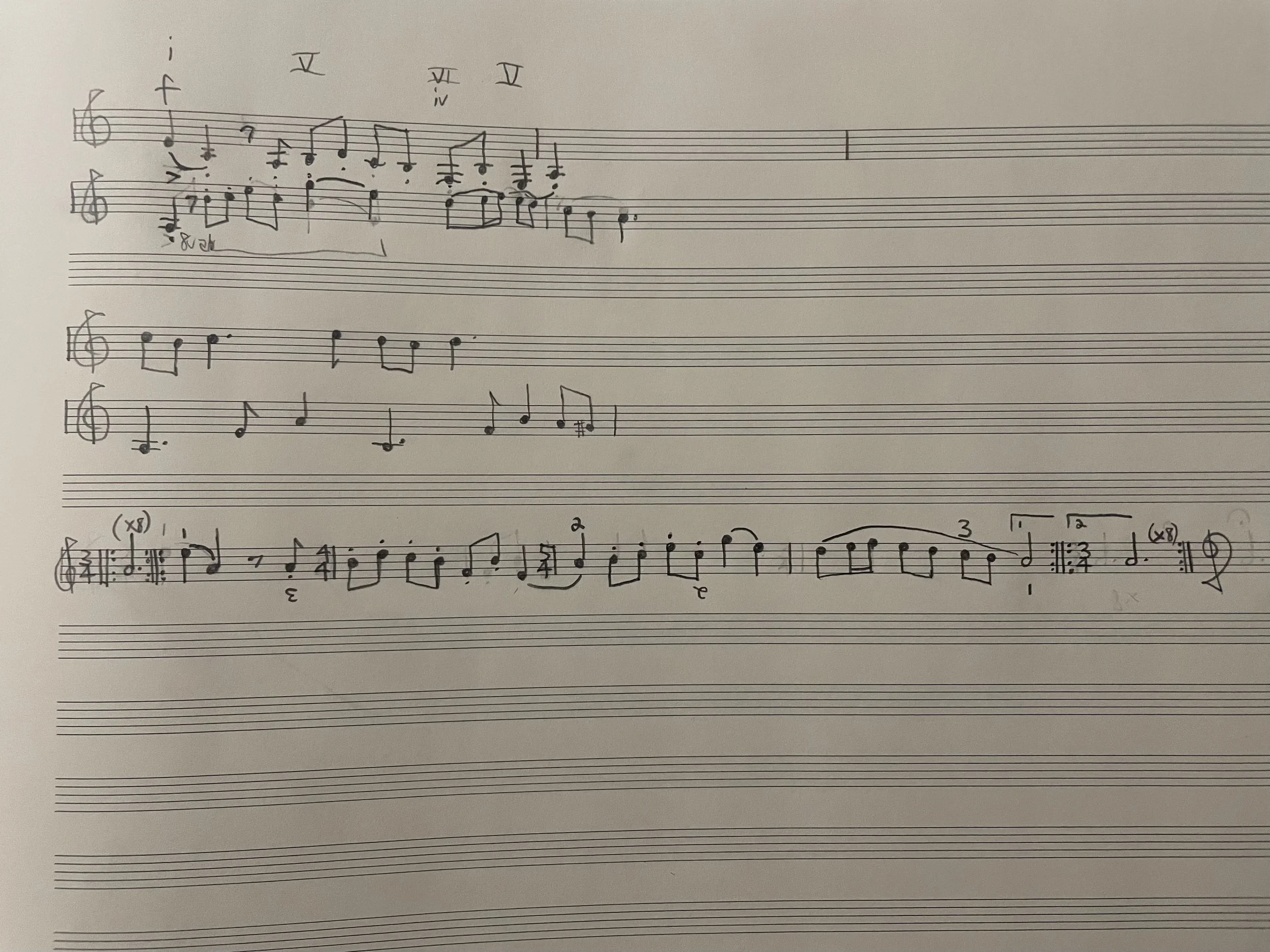
I took the image and sat down at my piano. That’s usually the first thing I’ll do, not even necessarily to play something, but maybe just to get in the creative mindset, I'll put the music stand flat on my piano and use it like a workstation. I laid out some paper and from there I started plunking around with what came to mind.
I feel like songwriting almost never works like this, where you're like, “Oh I have an idea and here it is! Great!” Sometimes it can take a lot to form an idea or extract an idea, but for whatever reason, this one came pretty easily. It was just that initial theme or melody I came up with: [sings part of a melody] I don't really know why that came to me—it just did. It almost felt like a march, so maybe thinking of the mountain, and striving, and purpose, and goals gave me a resolute march-like theme.
I do a lot of running and hiking, which applies to this. In general, a lot of the things I write tend to have some sort of repetition to them. I spend a lot of hours outside and a lot of hours in my head, and themes will just stick with me and repeat over and over. Relating back to the artwork, that was inspiring. My take on it was that I was looking at one thing but seeing it from all different angles. So in a similar way, I took this one initial theme, but I wondered: What if I try it an octave higher and stagger it a little bit? I started layering it and made it into a little fugue, which is when you take one melody, and then have another voice repeat it, but at staggered times. It creates neat textures and chords out of it.
I really liked ending it on a single long-held note, and then I recorded myself playing all the different voices so I could hear what it sounded like together. The long-held note created this kind of drone sound. I really liked how that sounded and wondered how neat it would be if I started the piece like that and it made a mirror image of itself. It started as just a musical idea, but then it kind of turned into creating a puzzle with music.
That’s awesome. I think it’s so fascinating that you started with this one motif, which was fine. It’s good. But then you did so many other interesting things with it. At some point, you turned your sheet music upside down?! I’d never heard of that before.
[laughs] I mean, full disclosure: I’m taking a composition class right now and we're studying people that have done this same exact thing. Mozart, for example, would write little puzzle pieces, as we’re calling them in class. Then you flip it upside down and it's supposed to kind of work both ways when you have two different singers singing the two different parts. So I definitely didn't come up with the idea myself. I didn't really have a plan, but I just thought, “How would that sound?” It's written in the key of A minor, so it sounds pretty serious and somber, and when I flipped the music upside-down and read it essentially backwards, it gave it a whole new sound. It sounded like it was in C major, so it went up a few keys and sounded a lot more, I guess, uplifted. The actual notes are a little higher and the way all the harmonies sound together is more spirited, uplifting, joyous.
I thought that was fitting because my takeaway from the artwork was like climbing a mountain and striving for the things I want in life. So how fitting would it be to end on an actual higher note?
So perfect! Sounds like a happy accident.
Totally. A lot of it was just sort of experimental, but then I realized that it works, and I like it, so I’m going to keep it.
How does this piece relate to the rest of your work?
It’s similar in terms of the driving beat and repetition behind it. That’s pretty similar to the stuff I write. But it’s different in that a lot of the stuff I write tends to be more dreamy or atmospheric. Also the way that the melody came to me for this one was different than other things I've written. There’s usually a lot of development that happens over time. I'll sit with an idea for a really long time and think about it a lot. With this one, it was kind of nice having a time constraint. “Okay, I only have two weeks to write this thing!” Maybe it was the artwork, maybe it was the time constraint, but instead of thinking on it for a long time, that really distinct melody just came out of it. And that's not typical. I don't know if it differs so much musically because I can think of other pieces I’ve written which may be similar, but I think the process of getting there was a lot more streamlined.
I see. Do you generally do well with deadlines?
That makes it way better. I do really well with having a due date. If it's open-ended, I'll probably just drag my feet and take forever to do it. Knowing it's coming up soon and then just making it really fast actually really works for me. I should just always only give myself two weeks to write something, or less. [laughs]
I'm not going to tell you not to! I also love a deadline. I’m doing one of those month-long challenges where there’s a different little prompt every day. And I have to do it every single day or they’ll pile up on me.
I like that. And having a prompt every day is great because if it's open-ended, that would almost make it harder. You’d have too many choices.
Oh for sure. I love a prompt. Had you ever worked from a visual prompt before?
No, I think that was my first time doing anything like this. I've gone to workshops where you paint based on the music you're hearing, and I'm not a painter! It was just a fun exercise for musicians. So I hadn’t done this before, but I really like it.
I'm glad you got to give it a shot! I have one more question. Now that you are on this side of our process, what is your advice to a new person getting their prompt today?
Don't overthink it. I tend to be pretty precious and particular about the stuff I do, but it's a good exercise to let go of that and see what comes to mind.
Call Number: B120PP | B121MU.deA
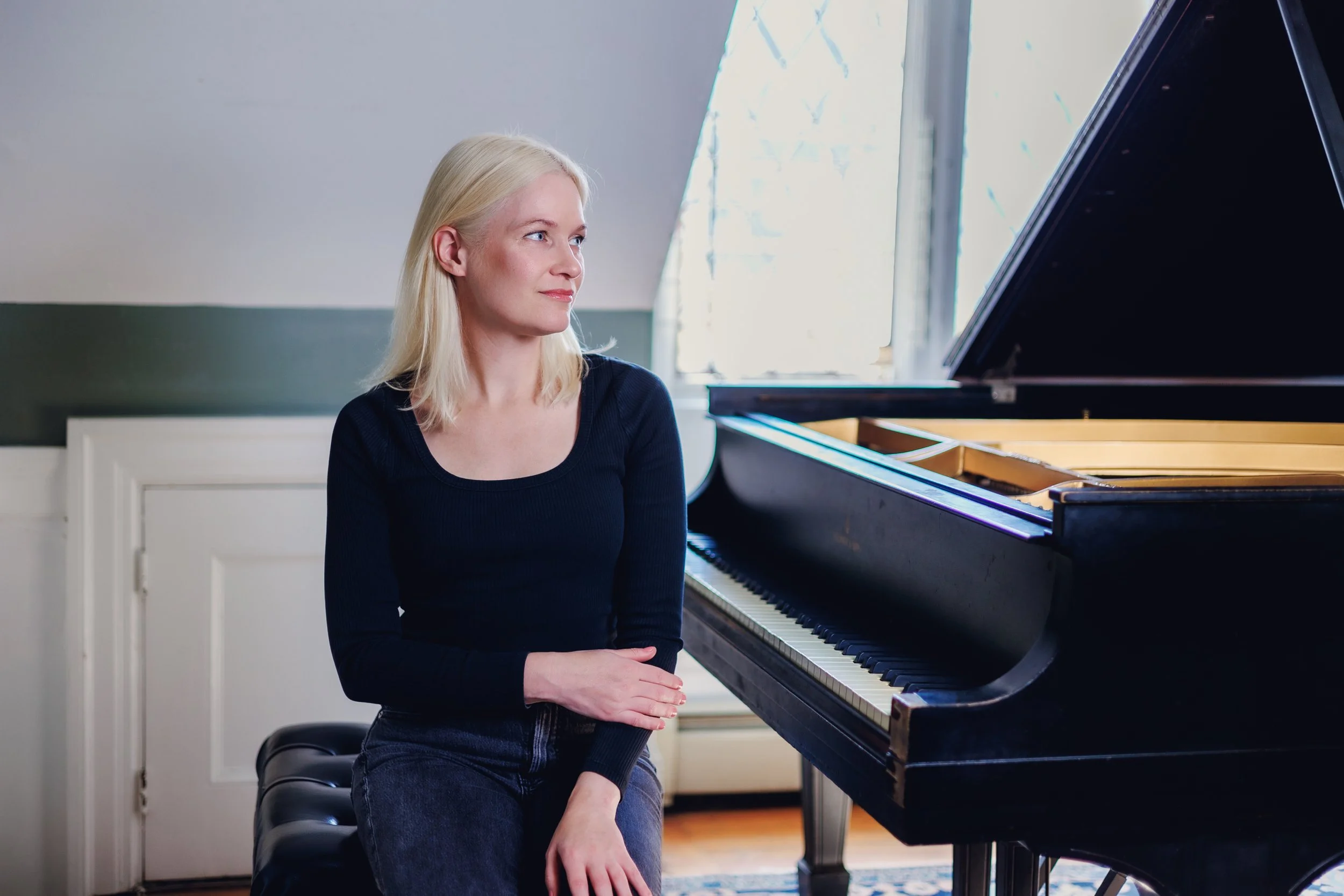
Liz Derstine is a pianist, composer, and avid trail runner and hiker. Her music is inspired by the copious amount of time she spends in nature. She lives in Boston with her soon-to-be husband Chris and two cats Bo and Juno.