
Caged Bird
Oscar Graves

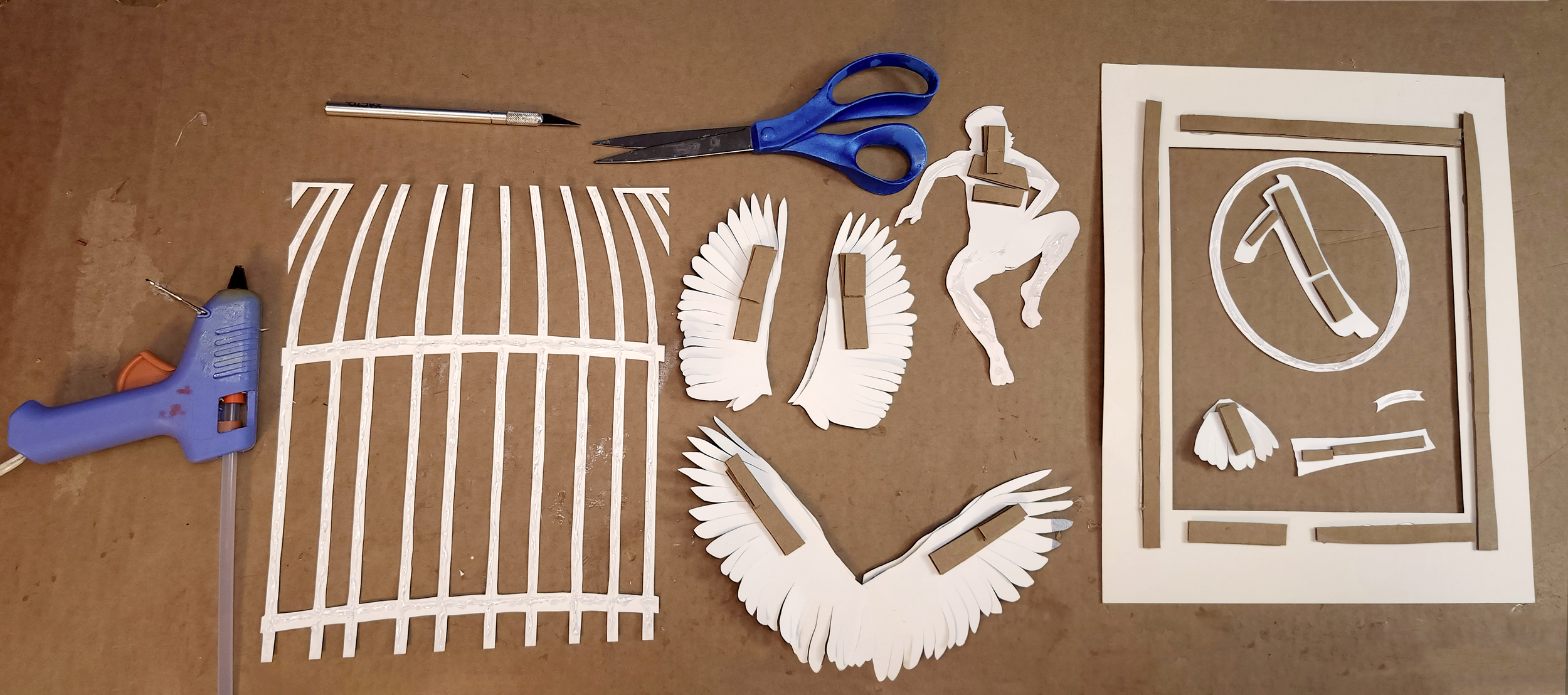
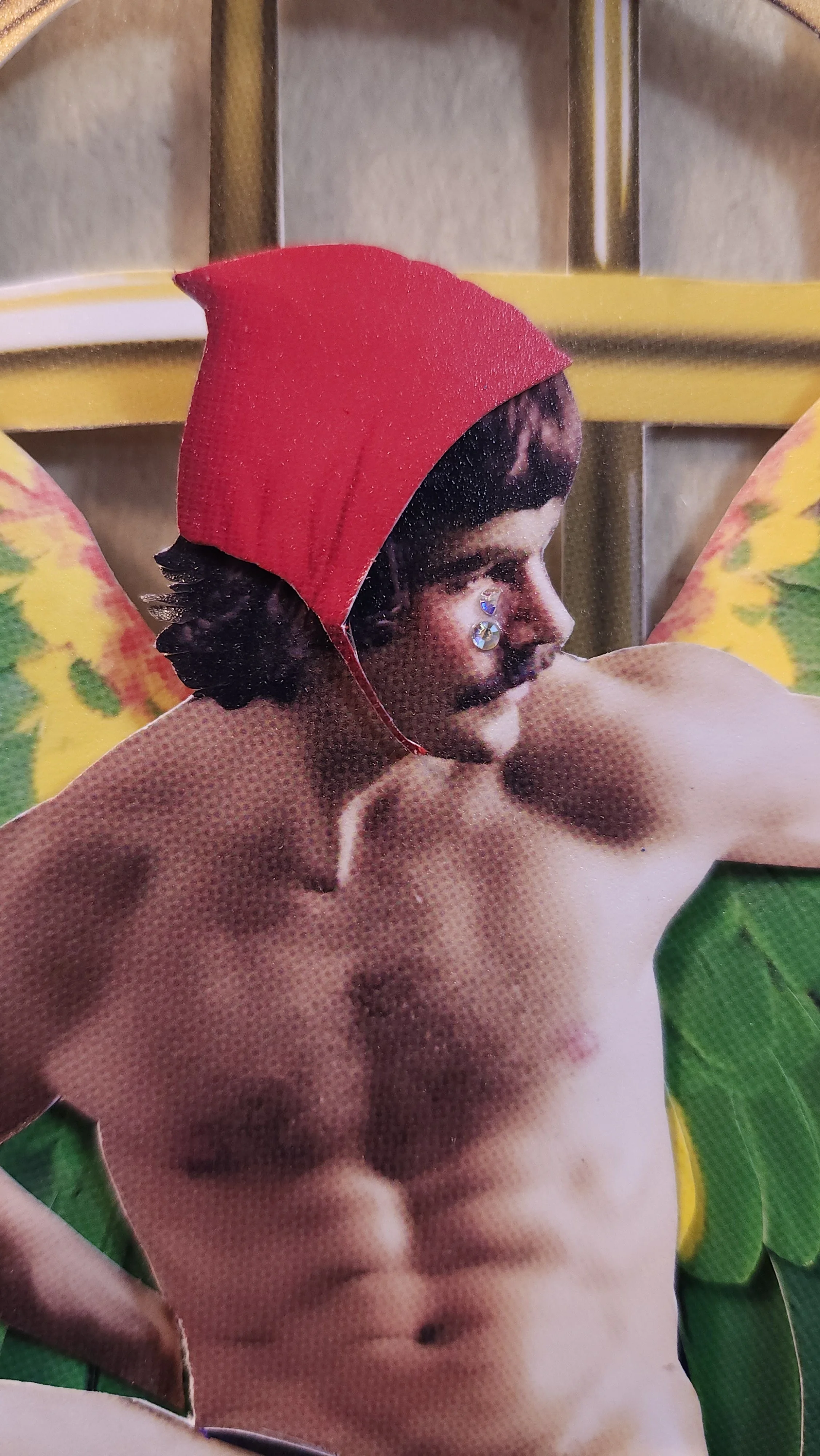
Caged Bird, 8x10 inch collage in a wooden frame: Photo paper, mat-board, cardboard, hot-glue, and rhinestones
“I guess I’m imagining a happier queer past for people.”
Interview by C. VanWinkle
May 18, 2025
What was the prompt that you responded to? Can you describe it for me?
It was two pictures of a sculptural piece that looked like blue and orange or brown feathers. They look like they're all glued onto some sort of beige, wax block. It was interesting to not have any description to go along with it. When I first saw it, it reminded me of work that I might see at a museum, which you really have to read the description to get an understanding of. I had a strong feeling that this meant quite a lot to the artist. It felt like very personal work, but I didn’t have access to what exactly it meant to them.
Without any guidance, what was your take on it?
Bird feathers are very interesting in an American context. I was thinking that maybe the artist was Indigenous and this was some sort of Indigenous reference. I didn't focus too much on an exact meaning and instead just took it as aesthetic inspiration, working with the theme of feathers.
How did you get started making your own piece?
I’m a collage artist and I've made many collages in which I’ve given boys wings, usually butterfly wings or moth wings. But I've also worked on winged boys with feathers, spending quite a lot of time cutting out the individual feathers to make them look more detailed. I ended up going with this idea of a Caged Bird. Another piece I made recently, a more serious, emotional piece, was a self-portrait called Plaything. It portrayed me as a little pixie sitting in someone's hand, but my butterfly wings had been ripped off. I guess maybe I’ve been channeling through some weird feelings about, you know, being a pretty boy in a gilded cage. [laughs]
I’m very much an aestheticist, so while I think it's nice when work has important meaning, it’s very important to me personally that art be beautiful. I still wanted to make something beautiful, and this particular collage is very much a classic Oscar Graves collage. It has a lot of the things that I like: a lot of gold detailing, a silly little red hat, tiny rhinestone teardrops on the model. I had to use the tiniest rhinestone that I had and then cut it in half with jewelry cutters. It’s so colorful, and it's erotic. It’s continuing this slightly newer direction for me where I'm exploring a bit more personal concepts while staying within my comfort zone of making beautiful things.
You talk about Plaything like it’s unusual for you to make a self-portrait. Is Caged Bird a form of self-portrait too?
In a way. I first moved to San Francisco when I was 18. I had a very hard time in my early 20s living here and I went through a series of abusive relationships. Looking back on it now at 33, I didn't even fully recognize that a lot of the relationships I was in were very much survival situations. I'm like a former kept boy in some contexts. My life in my early 20s had some very glamorous parts to it: I went on a lot of fun vacations, I had a lot of expensive underwear, but I was also very much like a caged bird. There were a lot of limitations to what I could actually do with my life, based on the decisions that my partners were making for me.
Honestly, for most of my art career, I've really hesitated to make more personal work. I’ve always used art as a way of soothing myself, meditating, taking a break from my sometimes very depressing, sometimes very traumatic life.
I think it’s worth noting a little demographic information about myself. I originally came to the United States as an illegal immigrant when I was three years old. Right after I moved to San Francisco, I became HIV-positive, and I lived in a homeless shelter for five years while I was going to college. When people look at my artwork, they don't see any of that because I don't want to wallow in those struggles. A lot of people want me to talk more about them, and I've always pulled away because I don't have anything to say other than, “It sucked.” I don't really want to make more stuff that focuses on how much it sucked. I want to make escapist art. I want to make happy things.
I've been seeing quite a lot of internet discourse about this. I hate the term "recession pop,” but it is a well-documented fact that during the Depression in the 1920s, movies became much more popular because people had such hard lives that they wanted to escape. I really focus on that in terms of wanting to make very joyful art.
Oh that makes sense. The escapism that we pursue is a direct result of what’s going on in our lives. It seems like your work always leans on vintage imagery, old magazines, and old beauty standards. What calls to you about that bygone era?
Okay, so I have been taught by my friends to say, “I love the aesthetics of the 50s and 60s.” I live in San Francisco and all my friends are rich, white liberals, so I like to jokingly trigger them by saying, “Aww, it was a better time!” And they’re like, “Surely you do not mean that sir!” [both laugh] I understand that nostalgia is a liar in a lot of ways, that things were not actually better. Especially as a gay artist making art using gay models from the 50s, 60s, and 70s, it’s important to remember that it was a much more difficult time then for Queer people of all kinds. A lot of the images I use are of physique models from the 50s and 60s, photos taken in a pre-Stonewall era. What I particularly like about older Queer erotica is that it feels very optimistic and joyful. It’s similar to my own purpose in that it’s an escapist fantasy.
Images in that type of pornography seem very commonplace now and not impressive. I think it's important for people to place themselves in the mindset of a closeted gay man who lived in a rural place, or maybe even a big city, and didn't know any other gay people. The only opportunity he had for a connection to the gay world was “Physique Pictorial” or “The Male Figure.” He would get these magazines and see a photo spread of two or three pretty boys hanging out, playing together naked in a pool. In 2025, pretty gay boys hanging out in a pool are unavoidable if you're gay and you have social media, but at that time, it was a crazy fantasy to imagine having a bunch of friends that you could have sex with, have a community with, be happy with.
One of my favorite things about the 50s through the 70s is that porn stars smiled in their photos. They were joyful in a way that you don’t see anymore. At a certain point, modern pornography, especially gay pornography, decided that you have to be serious and masculine. Modern models don't look approachable to me. They don’t want to talk to me or be my friend.
I'm also quite a big fan of the aesthetics of that era in general. From my modern point of view, a lot of the stuff is just ridiculous and crazy. The clothing is so out-there and foreign to me. It's very campy, it's very kitschy. I am also deeply influenced by musicals of the time, and campy, classic movies that were not meant for a gay audience, but are now loved by gay audiences.
In general, I think my collages are trying to combine the things that I really like about those eras. I really like the production value of musicals and cheap TV like “The Brady Bunch,” that sort of Technicolor look, and I also really like the Queer erotic photography of the time. But nobody ever made a “Barbarella” with a gay man as the lead. There were no gay directors who were able to make those types of movies yet. In the 80s and 90s, we had the beginning of some very campy gay directors, like Fred Halsted and Bruce LaBruce, making gay erotica that was gay in every sense of the word: kitschy, effeminate, sexy, all those things.
I guess I’m imagining a happier Queer past for people. I imagine that my artwork should have been made in the 50s, 60s, and 70s, but nobody quite had the access to it. The photos that I use for images, while still beautiful, just have no production value to them. The model will be holding a sword and wearing a Romanesque costume hat or helmet, implying what they wanted the rest of the image to be, but there is no backdrop. There are no other props. There is no real costume. Through the power of collage, I can finish what the intended image was supposed to be.
I see! You provide the set that they weren't standing on. It’s not too late.
Your work does look like it could have been made back in the day, not just with the imagery but also the techniques you use. You could easily do it digitally, but you go to the trouble to print everything, and cut everything out with scissors, and then put everything together. Why is it so important to you to stay analog?
I actually majored in printmaking in college and I really liked that it’s such an involved, multi-step process. It's not like drawing, where you can just start drawing on a piece of paper and then finish drawing on that piece of paper. If you wanted to make a print of the design, there were like 30 different steps that you had to do over the course of days, weeks, or months. You had to plan it out, and there's so much repetition and technical knowledge that’s required. I really liked the meticulous, repetitive nature and the ritual of it. You have to do it the right way. Some of the process I didn't even fully understand, but almost like a spell, I know that because I did it the right way, it did happen.
After I graduated, I was doing a lot of traditional, analog collage. Find magazines, cut them out, glue it together using Mod Podge. I didn't really like that process. I wanted to have more control. So eventually I switched over to making completely digital collages, which I did pretty exclusively for a few years. I would scan models from my collection of magazines or books, find various images online, pictures of a cage, a bird wing, this or that, and put it all together. In Photoshop, you can edit any image endlessly. The paper will not wear through and you can’t put too many layers of paint on it. I often spend 20, 40, 50 hours on just the digital version, fidgeting with the colors, with the scale of every single element, even digitally painting on top of some of the objects. I used to be very focused on making sure the shadows matched on every object. For example, in this piece the model is wearing a hat, but the shadows don't actually match up with the light on the model.
I've since learned to scale back a little on it. Experience has taught me that going too far into digital gives it that sort of digital sheen that people are desensitized to. People just didn't appreciate my digital-only artwork. They didn't understand how much work I was putting into it. This was way before AI, but they heard “Photoshop” and thought that I was just sort of typing it in and it was happening. No, I was working really hard for a very long time to make it happen!
Eventually, I got back into printing out the individual elements of the collage, piece by piece, and then putting them together. I think the general public understood what I was doing with cut paper more than they understood with the digital part. So I saw quite a lot more financial success selling hand-cut artwork, as opposed to prints of digital collages. I was a little bitter about it at first, but over time I came to appreciate that there were things that I could do with paper collage that I couldn't do digitally. I eventually married the two processes.
The digital versions are still beautiful, but every person who's ever seen any of my artwork in person always says, “These look good online, but they’re so much cooler in person.” Of course, Bait/Switch is all online, so you still have not seen the actual original piece. The whole piece is actually three-dimensional. The wings, the cage, the boy, every individual element is backed with cardboard, so even when pressed into a frame, they're still three-dimensional. They’re still a few centimeters off from each other and it creates a dynamic look with the shadows when you can move sideways and see the piece from different angles. Nowadays, I think of the physical experience of seeing my collages in person is like a “Thank you” for bothering to actually come to my show or gallery or event.
I can just imagine! Another reason for me to come to San Francisco. Now that you are on this side of our process, what's your advice for a new person getting their prompt today?
Don't be such a princess about it! I think it's very important for artists to step out of their comfort zone. I say that having not really stepped out of my comfort zone, but it was nice work from a prompt and do something that I don't normally do. As a collage artist, I'm in a very unique position because we do nothing but reference and find inspiration from other sources. My whole process is always about finding inspiration from anything and everything.
Call Number: G122VA | G123VA.graCa
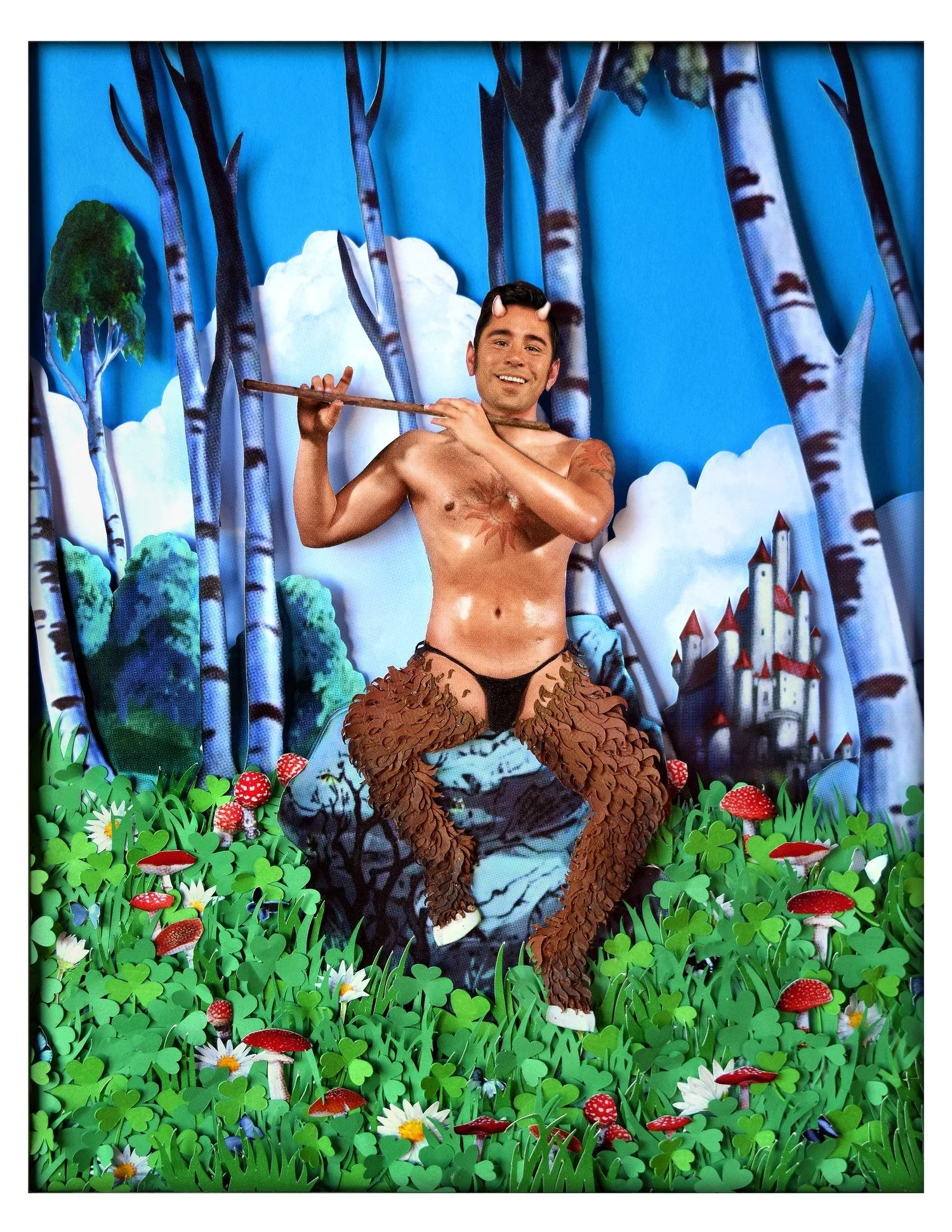
Oscar Zamora Graves is a collage and assemblage artist, heavily influenced by queer art and political history. His collages, innovatively combining traditional and digital media, blend nostalgia with queer maximalism to offer a unique perspective of modern gay erotic art through a fusion of physique and fantasy. An avid collector and archiver of vintage physique photography, his magazine and book collection is ever-expanding and open to the public (just ask).