

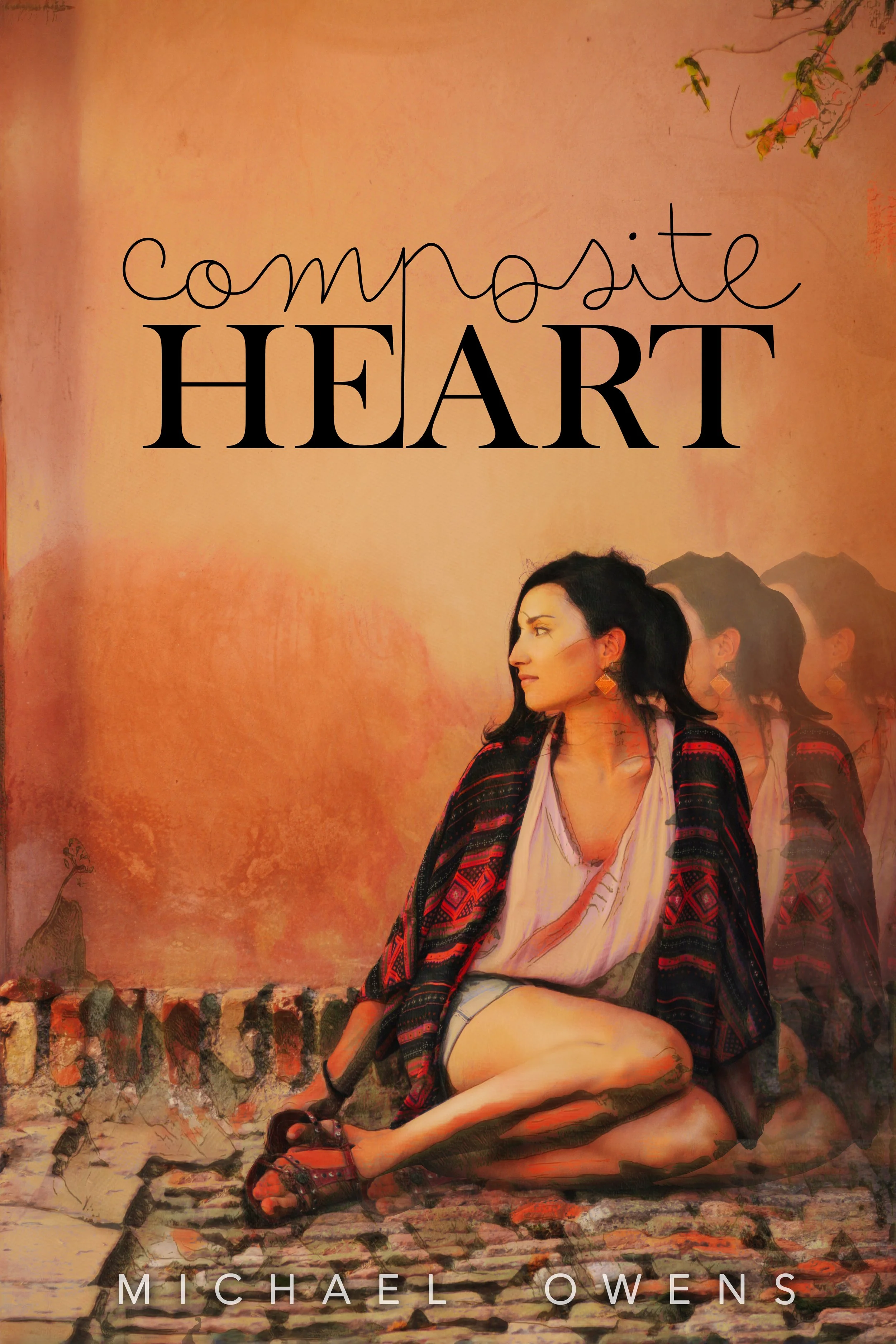
Composite Heart
Michael Owens
Chapter 1
Morning sunlight sliced through the narrow streets of Madrid, carving out shadows that crouched in doorways and beneath balconies. I wound my way through the labyrinth of the old city, each cobblestone beneath my boots a familiar pressure point. I rounded the butcher shop, where the scent of fresh blood and iron clung to the air, and emerged into a small plaza.
My favorite café nestled in the corner, its awning bleached to the soft white of old bones by the unforgiving sun. The building itself had stood for centuries, its walls absorbing conversations in voices long dead, witnessing alliances and betrayals over cups of bitter coffee.
I appreciated places with history.
The heat of the day was already upon us, but I pulled my sleeve over my wrist as the bell above the door chimed my arrival. The old barista at the counter barely looked up from the espresso machine, steam coiling around his liver-spotted hands.
"Café con leche," he said.
A statement, not a question.
"Gracias." Languages came and went from my tongue like passing seasons, but I maintained a deliberate foreignness. I was not a local here and never would be.
Connection invited questions. Questions invited touch.
The café hummed with the subdued industry of a Spanish morning. Two older men murmured over financial papers at a table against the far wall. An English couple hunched over a map by the windows, the woman's sunburned shoulders peeling in delicate pink flakes. Behind them an elderly man snapped his newspaper with each turn of the page.
I carried my drink to my customary table in the corner and pulled out my laptop, the metal surface cool against my fingertips. The first sip of coffee was barely bitter with an undertone of caramel, the milk creating cloud-like swirls.
Then, words.
My current manuscript centered on fifteenth-century Florence. The Medici family's rise to power, political intrigue woven through layers of art and poison. My fingers flew over the keys as the words flowed.
Your details are so vivid, my editor often said, as if you were actually there.
Indeed.
The café door chimed again, a disruption in the ambient soundtrack of clinking cups and quiet conversation. A young woman with flushed cheeks rushed across the cafe and ducked behind the counter. Dark curls sprang from a hastily arranged bun as she pulled on a clean apron and murmured softly to the old man.
My fingers paused, a momentary hesitation before resuming their dance across fifteenth-century Florence. Within seconds I was again lost in Lorenzo de Medici's calculated political marriages and the cool marble of his Florentine palazzo against the soles of my bare feet.
His chambermaid's name had been Allegra. She'd had a laugh like summer bells and a weakness for sugared figs. Her skin had been as warm and dark as the olives that grew along across the countryside.
A patch of that skin tingled now on the back of my arm, near my elbow, covered by the sleeve of my silk blouse.
The morning progressed in measured sips of cooling coffee. The businessmen left, replaced by students with textbooks and circles beneath their eyes. The pale tourists wandered off and were replaced by a swarthier couple who argued in whispered German.
You can’t really whisper in German, of course.
Hours passed and my fingers continued their steady rhythm, building worlds from a combination of memory and imagination.
"Another café con leche?" Not the usual barista's gravelly baritone but a brighter voice, almost musical.
The young woman stood beside my table, coffeepot in hand, her head tilted slightly as she studied my laptop. Amber eyes, intelligent and curious, reflected the sunlight. A small scar bisected her right eyebrow. Her lips, full and unpainted, parted slightly as she read the words on my screen.
I closed the computer with more force than necessary. "No, thank you."
"The Pazzi conspiracy?"
My spine stiffened and my eyes narrowed but I didn't reply.
"April 26, 1478." Her free hand gestured expressively. "During High Mass at the Florence Cathedral."
"That’s right," I admitted reluctantly. “American?”
"Yes,” she admitted with an apologetic smile, ”but my mother’s family is here in Madrid. I’m getting my master’s at the University." Her smile revealed a slight gap between her front teeth. "Are you S.A. Bennett?"
I glanced toward the door, calculating the steps to escape.
"I'm writing my thesis on women's hidden influence in Renaissance politics," she continued, oblivious to my discomfort. "Your novels have been invaluable. The way you write about Clarice Orsini and Lucrezia Tornabuoni, how they moved behind the scenes. You make them seem so real."
“They were real,” I bit out.
I'd taken tea with Lucrezia while she manipulated Florence's political landscape through carefully arranged marriages. Had borrowed a silk shawl from Clarice and never returned it. They had lived, breathed.
"I do a lot of research," I added flatly.
"I'm Raquel." She shifted the coffeepot to her left hand and extended her right toward me.
I stared at the offered hand, at the delicate blue veins visible beneath olive skin, at nails cut short and practical. My own hands remained firmly on the closed laptop.
Most people withdrew in embarrassment after a moment. Raquel's hand remained extended, her expression curious rather than offended.
"Germaphobe?" she asked.
"Something like that."
She withdrew her hand but not her attention. "I'll bring you fresh coffee anyway. On the house. Consider it thanks for helping me understand history better than any of my professors ever did."
She moved between tables with a dancer's grace and I struggled to tear my gaze away. A moment later she returned with fresh coffee, placing it precisely where the previous cup had been.
"Do you come here every day?" she asked.
"Yes."
"To write about Renaissance Italy?"
"To write," I corrected. "The subject varies."
She leaned slightly against the table, her hip inches from where my hand rested on the wood. "How do you make it feel so real? I could taste the air, feel the weight of the clothing."
"Research," I said again. "Just lots and lots of research."
"You're being modest." Her eyes reflected the fierce afternoon light as they pinned me to my chair. “What does the S stand for?”
"Sia," I said, surprising myself. "My friends call me Sia."
Her smile widened, creating a dimple in her left cheek. "Are we friends already, Sia?"
"No," I answered, smiling despite myself.
She laughed as if I'd made a joke, the sound bright against the cafe's muted tones. "We'll see about that."
I reopened my laptop as she sauntered away, hips swaying beneath her plain black skirt, but the words had fled, replaced by awareness of her movements at the periphery of my vision. The curve of her neck as she bent to wipe a table. The nimble movements of her fingers on the espresso machine. The low laugh that escaped her throat when the old man behind the bar said something in rapid Spanish.
Eventually I packed my laptop and retreated to my apartment. The building rose before me, a pre-war structure with ornate balconies and a temperamental elevator. Four flights of stairs later, I stepped into my sanctuary.
The apartment was cool and dark, heavy curtains blocking the Spanish sun. Bookshelves lined every wall, volumes arranged by era rather than author, reflecting my personal timeline spanning centuries. A simple desk faced the room's single window, positioned to catch the northern light. No photographs adorned the walls or surfaces. No mementos beyond the books themselves.
I moved to the bathroom, unbuttoning my blouse. Allegra’s skin, near my elbow, had thinned with age. My most recent acquisition was only thirty years old, a patch along my collarbone from a poet in Lisbon that was still supple and smooth. I carefully applied fragrant oils to the older sections that had begun to dry.
I traced the seam where my right arm joined my shoulder, the skin there peppered with a constellation of freckles. Emilia, an artist's model in Dublin. She had loved the smell of oil paints.
I had been so careful for so long.
Yet the next morning, I returned to the cafe, watching Raquel surreptitiously over the rim of my cup. Through sheer force of will I turned my attention to my manuscript, to the safe distance of five centuries and a thousand miles. Words came slowly now, reluctant soldiers marching into battle. My coffee cooled untouched as I struggled to remember what Lorenzo's voice had sounded like, when all my mind wanted to conjure was the musical lilt of Raquel's accented English.
After a morning of minimal progress, I surrendered to distraction. The café had filled with the midday crowd—mothers with strollers, businesspeople taking early lunches, tourists seeking refuge from the heat. Raquel moved among them with an easy confidence, switching between Spanish, English, and the occasional phrase in French or German.
She caught me staring and winked, a conspiratorial gesture that sent an unexpected warmth through my chest. I looked away immediately, gathering my belongings with mechanical precision. Laptop in case. Notebook and pen in side pocket. Coffee left unfinished, coins placed precisely beside the cup.
I stood to leave just as the café door opened, admitting a rush of hot air and a group of laughing students. Their bodies crowded the narrow path to the exit, a forest of flesh I had no desire to navigate. Physical contact with strangers presented minimal risk, but I avoided it nonetheless.
I retreated to the restroom instead, a small sanctuary of solitude. The mirror above the sink reflected a face carefully constructed to be forgettable: brown hair cut in a layered bob, minimal makeup, no distinctive features beyond eyes too old for the skin that housed them.
Raquel's reflection appeared beside mine, her vitality making my cultivated plainness even more apparent.
"You're leaving already?" she asked, disappointment evident in the downward turn of her mouth.
"I've written enough for today."
She stepped sideways, blocking my path without touching me. The small restroom suddenly seemed smaller, the air between us charged with something I hadn't felt in decades.
"I finish my shift at three," she said. "Maybe we could walk through the park and chat? About your books, about Florence. I have so many questions."
"Ask your professors. I'm not a teacher."
"Of course you are." The statement came with a smile that transformed her face, creating small creases at the corners of her eyes. "Please?"
"Why?"
Her eyebrows lifted at the bluntness of my question. "Because I've read everything you've written twice. Because your understanding of history speaks to me. Because you look at me like you're afraid I might bite." She leaned closer, her voice dropping to a whisper. "I don't bite, Sia. Unless you ask very nicely."
The flirtation hung in the air between us, unmistakable. Heat crawled up my neck, a sensation so long forgotten it took me moments to recognize it as embarrassment, with an edge of desire.
"I don't date," I said stiffly.
"Who said anything about dating? I'm proposing a professional conversation between two historians."
"With biting."
Her laugh echoed against the tile walls. "I think we should leave our options open."
I should walk past her, out of the café, back to my apartment with its carefully arranged furniture and empty rooms. Change my routine, find a new café, avoid this dangerous spark of connection.
"One hour," I heard myself say.
Her smile could have illuminated the darkest catacombs of Rome. "I'll meet you in the plaza at three."
She stepped aside, allowing me to pass without contact. As I navigated through the crowded café toward the exit, her scent lingered in my nostrils—coffee beans, cinnamon, and something like sun-warmed stone.
I spent the hours until three o'clock in restless activity. I returned to my apartment and changed my clothing three times, settling finally on a long-sleeved linen dress in deep blue. Applied and removed lipstick. Practiced conversation openers and exit strategies.
The walk back to the café took exactly ten minutes at my usual pace. I arrived as Raquel emerged from behind the counter, the black apron gone, revealing a simple white t-shirt tucked into high-waisted jeans. Her hair tumbled loose around her shoulders now, dark curls catching the afternoon light.
She spotted me immediately, her face brightening. "You came back."
"I said I would."
"People say many things." She gestured toward a table in the corner, more private than my usual spot by the window. "Sit and I’ll buy you a coffee."
“I thought you wanted to walk,” I protested weakly as I settled into the chair with my back to the wall.
"What would you like?" she asked, still standing.
"Café con leche."
"A creature of habit, I see." Her eyes laughed at me. "I'll be right back."
She returned moments later with two cups, placing one before me with a flourish. "So, S.A. Bennett, why do you write about the past instead of the present?"
Because the past is safer than the present. Because history doesn't ask questions I can't answer.
"There really is no difference. The past contains all human experiences," I said instead. "Love, loss, triumph, betrayal. Modern settings change, but human nature remains constant."
"Spoken like someone who has studied history extensively." Those remarkable amber eyes studied me with uncomfortable perception. "But there's more to it for you, isn't there? Your books don't just describe historical events. They inhabit them."
"I have a vivid imagination," I dismissed.
She sipped her coffee, leaving a small crescent of foam on her upper lip. A small pink tongue darted out to wipe it away. "When you write about Renaissance clothing, I can feel the weight of the fabric. I can taste the food, feel the breeze on my skin. It's more than research. It's more like memory."
The last word hung between us. I lifted my cup to hide my expression, the coffee slightly bitter against my tongue.
"All writers draw from personal experience," I said carefully. "We translate our own emotions into different contexts."
"Have you loved like Isabella d'Este? Have you hated like Catherine de Medici?"
"Haven't you?" I countered.
She considered this, head tilted slightly. "Perhaps." She leaned closer, her voice dropping. "Sometimes when I read your books, I think you must have been there."
My cup clattered against its saucer. Coffee sloshed over the rim, narrowly missing my sleeve. Raquel reached out instinctively, her fingers nearly brushing mine before I jerked my hand away.
"I'm sorry," she said immediately.
"It's fine." My voice sounded strained even to my own ears. "I should go."
"Please don't." She withdrew her hand completely, placing both in her lap beneath the table. "I've offended and that wasn't my intention."
"I’m fine." The lie tasted acrid on my tongue.
"I'm writing my thesis on women's influence in Renaissance politics." Her expression turned earnest. “Your insights could be invaluable."
A safer topic. I relaxed marginally. "What aspect are you focusing on?"
Her face lit with enthusiasm as she described her research, her theories about how women like Isabella d'Este and Lucrezia Borgia wielded power through cultural patronage and strategic marriages. Her intelligence shone through her analysis, her passion evident in the way her hands emerged from beneath the table to gesture emphatically as she spoke.
One hour stretched into two. The afternoon crowd thinned as evening approached. The barista replaced our empty cups with glasses of sangria "on the house," a knowing smile directed at Raquel that she answered with an eye roll.
"He thinks you're my type," she explained after he retreated.
"Am I?" The question escaped before I could reconsider.
"Mysterious, brilliant, beautiful?" Her smile turned mischievous. "Absolutely."
The compliment warmed places long cold within me. Dangerous warmth.
Dangerous woman.
"I should go," I said again, meaning it this time. "It's getting late."
"Walk with me first." She stood, gathering her small backpack. "Just to the plaza. The evening light is beautiful this time of year."
Madrid transformed at this hour. The harsh sunlight softened to burnished gold, casting long shadows across cobblestones. The air cooled just enough to draw people from their homes, filling the streets with voices and laughter. Raquel walked close beside me, careful not to touch, her scent mingling with the evening air.
"Do you ever write about Spain?" she asked as we entered the small plaza where a fountain bubbled, water droplets catching the fading light.
"Not yet."
"Why not?"
Because I haven't lived here long enough to absorb its essence, I thought. Because Spain is still present, not past. Because Spain contains you, and you are too dangerous to immortalize.
"I haven't found the right story yet," I said.
We stopped beside the fountain. Couples strolled arm in arm across the plaza. Children chased pigeons that scattered and reformed like shifting clouds. A street musician played guitar in the far corner, the notes drifting toward us on the evening breeze.
"May I show you something?" Raquel asked.
Before I could answer, she reached into her backpack and withdrew a book—my book. The cover showed a woman in an ornate gilded dress, face turned away from the viewer, Florence's Duomo rising in the background.
"One of my teachers gave me this when I was seventeen," she said, opening it to the title page. “It sparked my love of history."
The pages were dog-eared, the margins filled with neat handwriting. Notes, questions, observations. She had engaged with my words, argued with them, expanded upon them. The sight of her handwriting beside my text created an intimacy I hadn't anticipated.
"You've read it thoroughly," I managed.
"Many times." She turned to a specific page, pointing to a passage I'd written about Lucrezia Tornabuoni supervising the construction of a chapel. "This moment—when she insists on changing the placement of windows to better illuminate the altar—this made me understand that historical women weren't passive observers. That they shaped their world within the constraints placed upon them."
I remembered that day. Remembered Lucrezia's authoritative voice overriding the architect's protests. Remembered the sunlight through those windows at the consecration ceremony months later.
"I'm glad it resonated with you," I said quietly.
She closed the book, clutching it against her chest. "Will you sign it for me? Not now—I don't have a pen. But tomorrow, perhaps?"
The request contained an assumption: that we would meet again. That this afternoon was a beginning, not an ending.
"Raquel." Her name felt intimate on my tongue. "I don't think—"
"Don't think," she interrupted, stepping closer. "Just feel."
She moved slowly, deliberately, giving me time to retreat. Her hand rose toward my face, hovering a breath away from my cheek. I stood frozen, caught between desire and terror.
"May I?" she whispered.
I should say no. Should step back, walk away, return to safety. Instead, I nodded once, a sharp downward motion of my chin.
Her fingertips brushed my cheek, feather-light. Electricity arced from the point of contact, racing through my body. Her touch—the first I'd allowed in decades—burned like fire against my skin. Beneath my dress, the patchwork of borrowed flesh tingled, awakening.
"Your skin," she murmured, wonder in her voice. "It's like nothing I've ever touched."
I should have stepped away. Instead, I leaned into her touch, turned my face toward her palm.
"Sia," she breathed, my name a prayer on her lips.
She leaned forward, closing the distance between us. Her lips pressed against mine, soft and warm and tasting of sangria. The kiss was gentle at first, questioning, then deeper as I responded despite myself. Her free hand found my waist, steadying us both as the world spun.
Chapter 2
The evidence of Raquel's presence was scattered across my once-pristine apartment like artifacts from a forgotten civilization. Half-read books splayed open on the coffee table beside a forgotten coffee cup with a perfect crescent of lipstick on its rim. Even worse were the notes scribbled in the margins of my research materials—questions, connections, and the occasional drawings of flowers that seemed to bloom from her subconscious directly onto the page.
The apartment that had once been my sanctuary now pulsed with life. Her life. Our life, somehow intertwined despite my desperate attempts at maintaining distance.
"You're staring at my socks again," Raquel said without looking up from her thesis draft. She sat cross-legged on my sofa, papers spread around her like fallen autumn leaves, her mismatched socks—one striped blue and yellow, one solid red—a deliberate rebellion against order.
"They're an abomination."
"They're adorable." Knowing amber eyes caught the late afternoon light as they danced up at me.
I sighed in defeat and turned away, busying myself with the tea kettle. My carefully organized kitchen now contained Raquel's collection of novelty mugs, each bearing slogans or images that reflected her mercurial moods. Today I selected one that asked "got history?" in bold black letters.
"How's the thesis coming?" I asked, placing the mug on the coffee table, careful not to disturb her organized chaos of notes and books.
"Slowly." She tucked a curl behind her ear. "My advisor thinks I'm being too speculative about Isabella d'Este's political influence. He wants more 'concrete evidence' and fewer 'emotional interpretations.'"
"Men often mistake women's emotional intelligence for irrationality." I settled into the overstuffed leather armchair opposite her, maintaining the physical distance that had become our compromise. "Isabella understood that power flowed through relationships, not just official channels."
"Exactly!" Raquel's face lit with that particular enthusiasm that transformed her from merely beautiful to truly incandescent. "She cultivated artists and intellectuals not just for social prestige but as an alternative power structure when traditional politics excluded her."
"She also understood the power of spaces." The memory rose unbidden—Isabella's studiolo in Mantua, its walls adorned with paintings commissioned specifically to reflect her intellectual pursuits. "The way she arranged her collection created a narrative about her own sophistication and connections."
Raquel tilted her head, a familiar gesture that preceded her most penetrating insights. "You talk about her as if you knew her personally."
The observation sliced through my careful defenses. She was noticing more and more of my small slips. I'd become careless, complacent in our shared domesticity.
"Research," I said automatically, the word worn smooth from repetition.
"Research." She mimicked my tone perfectly, a hint of amusement curving her lips. "Your mysterious, time-traveling research that somehow lets you know exactly how the candlelight reflected off Isabella's emerald necklace during evening concerts."
"Imagination." Another well-worn deflection.
She set aside her papers and unfolded herself from the sofa, moving toward me with the deliberate grace that quickened my pulse. "Is that what you call it?"
She stopped before my chair, close enough that the scents of cinnamon and coffee enveloped me. My body responded to her proximity like a compass finding true north.
"What would you call it?" My voice was steady.
"Memory." She crouched before me, placing her hands on the armrests, not touching me but surrounding me. "I would call it memory, Sia."
"Your tea's getting cold," I said.
Her eyes never left mine. "I've been patient. Dancing around whatever secret keeps you awake at night. But you flinch when I touch certain parts of your body. And I see how you examine your skin in the bathroom mirror when you think I'm asleep."
A chill raced across my skin.
"Raquel—"
"I'm not asking you to explain." She reached forward slowly, telegraphing her movement, giving me time to withdraw. Her fingertips grazed my cheek, the contact electric and terrifying. "But I need you to know that whatever it is, it won't change how I feel about you."
Such dangerous confidence. Such beautiful, reckless certainty.
"You can't promise that," I whispered.
"Watch me." She leaned forward, pressing her lips to mine with the delicate precision that had become our ritual.
Raquel had learned the boundaries of my condition without understanding its nature. She knew which parts of my body could be touched, which remained forbidden. The soft press of lips, the gentle cradle of my face between her palms, these were safe.
Safe enough.
Her lips moved against mine, warm and insistent, tasting of tea and something uniquely Raquel that reminded me of stone walls and marble floors. My hands remained on the armrests, fingers digging into the cool leather as I fought the urge to pull her closer.
She drew back, studying my face with the intensity she usually reserved for ancient texts. "Dinner? I'm thinking about ordering paella from that place on the corner."
The sudden shift to domesticity broke the tension. "You're always thinking about paella."
"It's Spain. When in Rome."
"That makes no sense."
Her laugh, bright and spontaneous, filled the space between us. "There she is, my pedantic historian. Good to know you're still in there beneath all that relentless brooding."
She dropped a kiss on the top of my head—another carefully negotiated safe zone—before retrieving her phone from beneath a stack of papers.
In the kitchen, I selected a bottle from the rack that had appeared mysteriously after Raquel's third week in residence. The simple act of uncorking the wine, breathing in the rich aroma of cherries and oak, grounded me after the dangerous intimacy of our conversation.
In thirty minutes the bell rang and Raquel presented a plastic bag that emitted a heavenly, fragrant steam. She gestured to the dining room. "Shall we eat at the table and pretend to be civilized people?"
"Absolutely," I decided, needing the structure of proper dining to counterbalance the evening's emotional turbulence.
We settled across from each other, the paella plated between us. Raquel served generous portions on the mismatched dishes that had gradually replaced my monotone plates and bowls. The first bite exploded with saffron and paprika, tender seafood and perfectly cooked rice crisp at the edges.
"Good?" she asked, watching my expression with familiar intensity.
"Sublime." I took a sip of wine, the tannins balancing the richness of the dish. "The Romans would approve."
"High praise from my historical purist." She speared a shrimp with her fork. "So, I've been thinking about our summer plans."
The casual reference to a shared future sent a now-familiar pang through my chest.
"I have three weeks between submitting my thesis and my defense. I thought we might travel." She spoke lightly, but her eyes watched for my reaction. "I've never been to Florence."
The city where I'd loved and lost so many. The city I'd avoided for two centuries.
"Florence is crowded in summer," I said, focusing on my plate. "Tourists everywhere."
"We could go somewhere else. Venice? Rome?"
More cities filled with ghosts, with pieces of my past literally grafted to my body. "Northern Spain is beautiful in summer."
Raquel set down her fork, all pretense of casualness abandoned. "I want to see Florence through your eyes. A place you know."
"I know Spain," I offered weakly.
"No, you don't. Not really." She leaned forward, eyes intent. "You live here like a visitor. You speak Spanish like someone determined to remain foreign. You navigate this city with Google Maps despite having lived here for years."
"I move around frequently," I protested, the closest to truth I could manage. "It doesn't make sense to put down roots."
"Roots." She repeated the word thoughtfully. "Is that what you're afraid of?"
The truth was so much more complex. I'd put down roots in many places, for many years. But Florence had always been home. Until it wasn’t. Until it couldn’t be.
"I haven’t been back to Florence for a very long time," I said finally.
Raquel's expression softened. "It’s still there."
"The food’s getting cold," I said, another weak diversion.
She allowed it, returning to her meal with a small sigh that spoke volumes about her patience and frustration. We ate in silence for several minutes, the scrape of forks against plates the only sound in the apartment.
After dinner, Raquel returned to her thesis while I cleaned up, finding comfort in the simple ritual. The warm water soothed my agitated thoughts, the mechanical task of scrubbing and rinsing creating space for my mind to settle.
By the time I finished, night had fallen completely. Through the kitchen window, Madrid sparkled with lights, a galaxy of human existence spread beneath us. Raquel remained absorbed in her work, curls falling across her face as she bent over her laptop, teeth worrying her bottom lip in concentration.
I slipped into the bathroom, locking the door behind me. With methodical precision, I unbuttoned my blouse, letting it fall from my shoulders. The mirror reflected what I kept hidden from the world and from Raquel, despite our physical intimacy.
My body was a patchwork of stolen skin.
The newest section along my collarbone had begun to dry at the edges, the once-seamless join now visible as a hairline crack. I pressed my fingertips to it gently, feeling the slight ridge that hadn't been there a week ago. The pain came instantly, radiating outward from the point of contact.
I sucked in a breath, biting my lip to keep from making a sound that might alert Raquel. The hunger that accompanied the pain was a gnawing emptiness that started beneath my sternum and spread throughout my body.
With the poet in Lisbon, I'd vowed it would be the last time. I would allow my body to deteriorate, would endure the hunger until it consumed me instead. A fitting end to an existence that had already lasted for far too long.
Then I met Raquel.
A soft knock at the bathroom door startled me.
"Sia?" Raquel's voice carried concern. "Are you okay? You've been in there a while."
"Fine," I called, hastily rebuttoning my blouse with trembling fingers. "Just washing up."
"Can I come in? I need to brush my teeth before bed."
Our nightly rituals included sharing the bathroom as we prepared for sleep, moving around each other in the intimate dance of domesticity. Usually, I kept my body covered, limiting her access to the safe zones we'd established through careful negotiation. Tonight, with the pain radiating from my collarbone and the hunger gnawing at my insides, even that felt dangerous.
"Give me a minute," I stalled, splashing cold water on my face, hoping it would ease the fever of incipient decay.
When I opened the door, Raquel stood waiting in an oversized t-shirt that fell to mid-thigh, revealing long, smooth legs. Her hair was piled atop her head in a messy bun, tendrils escaping to frame her face.
"All yours," I said, attempting to slide past her without contact.
Her hand caught my wrist gently, but with enough intention to stop me. "You're in pain."
Not a question. An observation delivered with the confidence of someone who had been watching closely.
"Just tired," I lied. "The wine, perhaps."
"Liar." Her voice held no accusation, only certainty. "You've been rubbing your collarbone all evening."
"It's nothing."
"Show me."
"Raquel—"
"Show me," she repeated, firmer now. "Whatever it is, whatever you're hiding."
The bathroom light was harsh, illuminating the determination in her eyes. For months, she had respected my boundaries, had accepted the limitations I placed on our physical intimacy without demanding explanations. Now, she was drawing a line of her own.
"You don't understand what you're asking," I said quietly.
"Then help me understand." Her grip on my wrist loosened but didn't release. "I'm not afraid, Sia."
"You should be."
The words escaped before I could stop them. Raquel's expression shifted, surprise giving way to curiosity, but also a tenderness that cut more deeply than my fear.
"Let me decide what should frighten me," she said.
We stood frozen in the bathroom doorway, her hand warm around my wrist, her eyes unwavering. We had reached a precipice. I could pull away, maintain my secrets, continue the careful dance of half-truths that had defined our relationship until now. Or I could show her. I could do as she asked and reveal the monster that lurked beneath my careful disguise.
And watch the love in her eyes transform to horror.
The decision crystallized with sudden clarity. If I was truly determined to end this existence, this was the first step. I had to let Raquel go.
With trembling fingers, I began unbuttoning my blouse again. Raquel's eyes widened slightly but she remained silent, watching as I revealed inch by inch what I had kept hidden for months through dark rooms and careful choreography.
The blouse slipped from my shoulders, pooling at my elbows. Raquel's sharp intake of breath cut through the silence.
My torso was a patchwork of different tones and textures, some matching my face and hands, others darker or lighter. The smallest was the size of my palm, the largest encompassed nearly the entirety of my left flank. The seams between them were visibly thinner in places, hinting at a darkness beneath.
"Sia." My name on her lips contained multitudes. There was shock, confusion, and concern. Her eyes traveled across my exposed skin, taking in the complex tapestry of my existence. "What am I looking at?"
I searched her eyes for disgust, knowing it must be there, but the pragmatic question was so typically Raquel that a humorless laugh escaped me. "My past."
Her brows drew together in concentration rather than revulsion. "These are from different people?"
"Yes."
"Lovers?" Her mind was so quick.
“Yes.”
“How?”
Another quintessential Raquel question. Not 'why' but 'how'.
"I don't know how," I admitted. "And I don’t know why. My body decays and I begin to hunger. The person closest to me, the person that I..." The word caught in my throat.
"Love," she finished for me, eyes meeting mine in the mirror.
I nodded, unable to finish.
Her hand lifted, hovering inches from my exposed shoulder where the skin of a Renaissance courtesan met that of a Parisian painter. “How long?”
I closed my eyes. “Six hundred and twenty-five years.” When I opened my eyes again, her gaze pierced mine.
“You will tell me everything,” she threatened with the avarice of a historian presented with her wildest dream. “Every detail.”
I nodded, resigned.
"How long?” she asked again. “Until you need to..." She hesitated, searching for a delicate way to phrase the horrific truth.
"Consume?" I supplied, deliberately harsh. "Months. Less than a year."
Her hand remained suspended between us, neither withdrawing in horror nor closing the distance to touch. "And then?"
"I die. Finally." The words emerged with unexpected serenity. "That was my plan, before I met you. To let this body fail, to endure the hunger until it turned on itself instead of someone else."
Understanding dawned in her eyes. "That's why you pushed me away at first. Why you tried to maintain distance."
"Yes."
Her hand finally moved, but not to touch my patchwork skin. Instead, she reached for my face, cupping my cheek with a gentleness that threatened to shatter my composure. "Oh, Sia."
"Now you understand," I whispered. "Why I can't plan for summer holidays. Why this has to be temporary."
"No." The word emerged with startling firmness. "I understand why you think it must be temporary. That's not the same thing."
I stepped back, pulling my blouse closed. "Raquel, do you not understand what I am? What I've done?"
"I understand what you are." Her chin lifted with the stubborn determination I'd come to both love and dread. "You're a woman who has survived for centuries by incorporating those you love into yourself. Literally."
Put that way, it sounded more poetic than monstrous. "And that doesn't scare you?"
"I’m scared for you, not of you," she said.
I stared at her, searching for any sign of disgust or fear. Instead, I found only the intense curiosity that had drawn me to her from the beginning.
"You're taking this remarkably well," I said cautiously.
"Am I?" A small, wry smile curved her lips. "Perhaps it's shock. Perhaps it's that I've suspected something extraordinary about you since we met. Or perhaps it's simply that I love you, Sia. All of you, including the parts you've been so desperate to hide."
The declaration stole my breath. "You can't love what I am."
"Watch me."
* * *
The days following my revelation unfolded with surreal normalcy. Raquel asked precise, well thought out questions about the mechanics of my condition, the historical periods I'd witnessed, the people who now formed parts of my physical being. She took notes, cross-referenced details with historical records, approached my impossible existence with the same scholarly rigor she applied to her academic pursuits.
"Tell me about this one," she asked one evening, her fingertip hovering above a patch of skin along my ribcage, not quite touching.
We sat on our bed, my body exposed to her curious gaze. These examinations had become a nightly ritual—Raquel mapping my body with scholarly precision, collecting the stories written in my flesh, creating a timeline of my existence through physical evidence.
"Lucrezia Tornabuoni," I said, the memory rising with surprising clarity. "Florence, 1470s. She had the most beautiful singing voice—clear as a bell, with perfect pitch. Lorenzo would sometimes request she sing during intimate family gatherings."
"The same Lucrezia who changed the chapel windows?"
"The same." I smiled at her academic cross-referencing. "Her son became one of the most powerful men in Florence."
"Lorenzo the Magnificent." Raquel's eyes lit with recognition. "I've studied him extensively. Did you know him well?"
"Well enough to avoid his political machinations." The memory of Lorenzo's calculating gaze still raised goosebumps on my arms centuries later. "He suspected I wasn't what I claimed to be—a distant cousin from Milan. Too observant for comfort."
"Did you love her?"
A question delivered with genuine curiosity rather than judgment. "Yes, in my way. Though perhaps not as deeply as she deserved."
Raquel nodded, absorbing this information with the same careful attention she gave to primary historical sources. "And this one?" Her attention shifted to my left forearm, where a swath of olive skin contrasted with the paler tone of my upper arm.
"Emilia. An artist's model in Florence, about a century later. She posed for Botticelli."
Raquel's eyes widened. "Botticelli? Was she in any paintings I would recognize?"
"Several minor works. And she was one of the models for Flora in Primavera, though he changed her features slightly."
"That's extraordinary." Her voice held the reverent awe of a historian touching the past directly. "You've carried their stories—their very essence—through centuries."
The observation startled me. I had never considered my condition in those terms—as preservation rather than consumption, as witness rather than predator.
"That's a generous interpretation," I said carefully.
"Is it?" She tilted her head, studying me with that penetrating gaze that saw too much. "How would you interpret it?"
"As theft. As..." I hesitated, searching for the right word. "Parasitism."
"Interesting." She sat back, academic mode fully engaged. "But parasites take without giving anything in return. You've kept their memories alive. You've carried them through time. That's a form of immortality few humans ever achieve."
"They didn't consent to this immortality."
"Did you?"
Had I consented to this existence? To this cycle of love and loss and incorporation? The origin of my condition remained lost in the fog of early memory—a fever, perhaps, or a curse, or something less dramatic but equally transformative.
"No," I admitted finally. "I didn't choose this. You have a unique talent for complicating my narratives," I said, attempting to lighten the atmosphere.
Her smile broke through, bright and genuine. "That's what historians do, isn't it? Complicate simplistic narratives with nuance and context."
"Is that what you're doing? Contextualizing me?"
"I'm trying to understand you." She leaned forward, pressing a gentle kiss to my forehead. "All of you."
The tenderness of the gesture, the acceptance it implied, threatened to undo me.
"What did I do to deserve you?" The question emerged as barely more than a whisper.
"Lived long enough to find me." Her answer came without hesitation, accompanied by another kiss, this one pressed to my lips.
Chapter 3
The mountains caught the late afternoon light like ancient sentinels, their granite peaks turning rose-gold against the deepening blue sky. My rental car struggled up the winding road, engine protesting each steep incline. The GPS had lost signal thirty minutes ago, forcing me to rely on the hastily scrawled directions provided by the property manager.
Solitude awaited at the end of this journey. Sanctuary and safety. The latter for Raquel, if not for me.
I adjusted my position, trying to find relief from the searing pain that radiated from my chest. The skin there had begun to separate more rapidly in the past week, fine cracks extending like fault lines across my flesh. The hunger that accompanied the deterioration had become a constant companion, an emptiness that nothing could satisfy.
The road narrowed as it climbed higher, pine trees crowding close on either side. My phone displayed the same message it had for the past twenty kilometers: No Service. Perfect. Isolation had been my primary criterion when arranging this hasty retreat—that, and distance from Madrid.
From Raquel.
I hadn't had the courage to leave while she was awake, to withstand the force of her arguments and the power of her touch. Instead, I'd slipped away before dawn, leaving only a carefully composed letter on the pillow where my head should have been.
The road curved sharply, revealing a traditional Spanish farmhouse of weathered stone with a terra cotta roof, surrounded by olive groves and vineyards that stretched toward distant mountains.
I navigated the final ascent carefully, the rental car's tires crunching on gravel. The property manager had promised the caretakers would stock the kitchen before departing, honoring my request for complete privacy. The substantial cash bonus I'd offered had ensured their discretion.
The car rolled to a stop in the courtyard. Stepping out into the late afternoon heat sent a fresh wave of pain cascading from my collarbone down my arm. I leaned against the vehicle, breathing slowly as I focused on the scent of wild rosemary and sun-baked earth, the distant trickle of water from an unseen fountain, and the rustle of olive leaves in the gentle breeze.
When the pain subsided to its usual dull throb, I retrieved my single suitcase from the trunk. I’d brought my laptop, though I doubted I'd write.
The finca's interior proved as advertised: rustic but comfortable. The main room featured a massive stone fireplace, heavy wooden furniture softened by handwoven textiles, walls of the same weathered stone as the exterior. Windows set deep in the thick walls admitted slanting golden light that illuminated dancing dust motes.
I moved through the space methodically, cataloging its features and contents. The kitchen was well-equipped and the bathroom surprisingly luxurious with its deep soaking tub and rainfall shower. The large bedroom was dominated by a massive bed with an ornately carved headboard and clean, crisp linens.
A comfortable place as any to die.
I unpacked methodically, arranging my meager belongings in the ancient armoire. My fingers lingered on the soft cotton of Raquel's t-shirt, stolen from the laundry before my departure. A sentimental indulgence that I couldn’t bring myself to regret. I buried my face in the fabric now, breathing deeply the scents of cinnamon and coffee, paper and ink, the indefinable essence that was uniquely Raquel.
I couldn’t hold in a gasp as the pain flared, brighter than ever. The hunger twisted beneath my ribs like a living creature. I dropped the shirt as if burned, shoving it deep into a drawer.
Sleep proved elusive that night, pain and hunger conspiring to chase away any semblance of peace. I lay in the massive bed, moonlight streaming through windows I'd left uncurtained and tried not to remember.
My existence had stretched across centuries, sustained by a process I neither understood nor controlled. The hunger came, the body failed, consumption followed. It was a cycle as predictable as the seasons, as unstoppable as tides.
Until now.
Dawn transformed the bedroom, turning simple stone and wood into a sun-gilt tapestry. I rose, moving carefully to minimize pain, and brewed coffee. The aroma filled the space, rich and comforting, momentarily distracting from the hollow ache beneath my ribs.
I established routines in the days that followed—simple patterns to mark time's passage and provide structure to what might otherwise become formless waiting. Mornings began with coffee on the porch, watching light transform the landscape. Afternoons included short walks among the olive trees when pain permitted, or reading when it did not. Evenings brought wine and contemplation.
I documented my deterioration with clinical detachment, making notes in a journal as if observing a subject separate from myself.
Systemic failure. Accelerating decay.
The hunger became harder to ignore as deterioration progressed. It manifested not just as emptiness but as desire—intense, specific cravings for connection, for touch, for consumption. My dreams, when sleep finally came, were filled with dark images. I woke from these dreams sweating and trembling, teeth aching with the need to tear and consume.
I redoubled my commitment to isolation during these episodes. No matter how intense the hunger grew, no one was at risk here in this remote location. No one would suffer for my condition. No one would be consumed by my pain, except for me.
Thoughts of Raquel became both torment and comfort. I imagined her in Madrid, perhaps concerned at first, then angry, finally accepting that I had made a choice she must respect. I pictured her focusing on her thesis. I envisioned her finding someone worthy of her brilliant mind and generous spirit, building a life uncomplicated by my centuries worth of baggage.
The scenarios were cold comfort on nights when pain prevented sleep and hunger clawed at my insides with increasing ferocity. But they reinforced my resolve—better temporary hurt than eternal imprisonment within my cursed flesh.
On the one hundredth day of my self-imposed exile, a thunderstorm rolled through the valley below me, transforming the landscape with dramatic intensity. Lightning split the sky in jagged branches, thunder rattled ancient windows and rain lashed against stone walls with percussive force.
The violence matched my internal state. My systems were failing and my hunger raged. My control was fraying at edges worn thin by pain and isolation.
When dawn broke after the stormy night, the world was washed clean, colors more vibrant, scents intensified by rain-soaked earth. I sat on the porch with my morning coffee, admiring how water droplets caught light like countless tiny prisms, transforming ordinary olive leaves into extraordinary jeweled creations.
From beyond the bend, tires crunched on gravel and an engine purred. Visitors were impossible; I had paid handsomely for my privacy. Perhaps the caretakers had returned early, ignoring my explicit instructions.
I rose painfully from the chair, coffee cup still in hand, and moved to the edge of the porch for a better view of the approaching intruder.
The coffee cup slipped from my weakened grip and shattered against stone.
Raquel emerged from the car and stood in the courtyard, one hand shielding her eyes against the morning sun, the other clutching a small backpack. Her hair was longer and pulled back in a hasty ponytail, curls escaping to frame her face. She wore hiking boots, jeans, and a simple white t-shirt that gleamed in the sunlight.
Impossible. Miraculous. Disastrous.
"I knew you'd choose somewhere beautiful to hide," she said calmly as she walked toward me. "You have excellent taste. It’s your judgment that sucks."
"You shouldn't be here," I managed, voice rough from disuse. "How did you find me?"
"With considerable difficulty." She reached the porch steps but paused, respecting the boundary I'd established with my retreat. "You covered your tracks well. But you forget I'm also good at research."
"Raquel." Her name emerged as both plea and warning. "You need to leave. It’s dangerous."
"No." The single syllable contained all her characteristic stubbornness. "I didn't drive through half of rural Spain, bribe three different property managers, and sleep in my car for two nights to turn around without you hearing me out."
"It's not safe." I wrapped my arms around my torso, partly from the pain radiating through my chest, partly to physically contain the hunger that surged at her presence.
Those perceptive amber eyes that missed nothing cataloged my appearance with scientific precision. "You look terrible."
"Rude." It was true, of course. After all, I was actively dying.
"I'm not trying to flatter you." She mounted the first step, then the second. "It’s an observation. You're suffering unnecessarily."
The reduction of my condition startled a harsh laugh from my throat. "There's nothing unnecessary about it. This is the natural conclusion to an unnatural existence."
"Bullshit." She reached the top step, and I backed away. "Martyrdom is inherently selfish."
"Selfish?" Indignation momentarily overcame caution and I paused in my retreat. "I’m protecting you."
"You’re protecting yourself." Another step closer. "From having to watch me make my own choices. From having to accept that I might choose you. All of you, including the parts you consider monstrous."
Her assessment struck like a physical blow. I retreated until my back pressed against the stone wall of the house. I had nowhere left to run.
"You don't understand what you're saying," I insisted. "The hunger is worse than before. Worse than I've experienced in centuries."
"Because you're fighting it." Another step. The breeze brought her scent to me, road dust and coffee, sunshine and determination. "Because you're denying what you are, what you need."
"What I need is for you to leave." The words emerged sharper than intended, desperation lending them a cutting edge. "Please, Raquel. While you still can."
She stopped advancing, but not from fear. Her head tilted slightly, gaze assessing my condition with uncomfortable accuracy.
"How much pain?" she asked, voice clinically detached.
"Considerable."
"And the hunger?"
"Worse than the pain."
She nodded, absorbing this information with scholarly detachment that belied the moisture gathering in her eyes. "May I come closer?"
The request pierced through layers of defensive isolation. I nodded once, a short jerking motion that sent fresh pain cascading through my body. I sank down into one of the benches on the porch.
Raquel closed the remaining distance between us with careful steps.
"I’ve searched for you from the moment I found your note," she said as she came closer, voice conversational as if discussing ordinary matters. "First the logical places—hotels where you'd stayed before, locations you'd mentioned in your writing. Then I got creative."
"How?" The question escaped despite my determination to maintain emotional distance.
"I cross-referenced properties recently rented in remote areas with the publication dates of your novels." A small, satisfied smile curved her lips. "You tend to retreat to isolated locations when finishing a manuscript. The pattern was clear once I looked for it."
"Clever." The compliment emerged reluctantly.
"Historian, remember? Patterns are my specialty." She came to a stop an arm's length away, close enough to touch. "What's your plan here, Sia? Sit alone in pain until you die? How long will that take?"
"I don't know precisely. Days. Weeks, perhaps. No more than two."
"And you consider this preferable to the alternative?"
"Yes." No hesitation in my response. "Infinitely preferable."
Her eyes held mine, unflinching. "What if that's my choice to make, not yours?"
The implication struck like lightning, electric and devastating. "No."
"No what?"
"No, you don't get to make that choice." I struggled to rise, pain forcing me back down. "This isn't some romantic sacrifice, Raquel. It's consumption. Absorption. The literal incorporation of your flesh into mine."
"I understand the mechanics." Her voice remained steady, reasonable. "You've explained them thoroughly, and I've seen the evidence firsthand."
"Then you understand why it's not an option."
"I understand why you think it's not an option." She reached for my hand, gently closing her warm fingers over mine. "What if this isn’t death? What if this is the most profound connection two beings can share?"
The suggestion that my curse might be viewed as the ultimate intimacy created a cognitive dissonance that momentarily silenced my objections.
"You've carried pieces of those you've loved through centuries," she continued, pressing her advantage. "Their memories, their experiences, aspects of their consciousness preserved within you. That's not destruction, Sia. That's a form of immortality few humans ever achieve."
"They didn't choose it."
"I am choosing it." Her fingers tightened around mine. "Fully informed, eyes open, with complete awareness of what it means."
"You can't possibly understand—"
"Stop telling me what I can and cannot understand." The first flash of anger colored her words. "I've spent months studying your condition, cataloging your experiences, analyzing the historical implications. I've approached this as both scholar and lover. Don't dismiss my comprehension because it doesn't fit your narrative of solitary suffering."
The rebuke stung with its accuracy. Raquel had indeed approached my condition with remarkable rigor, asking questions that forced me to articulate aspects of my existence I'd never previously examined.
"Even if you understand intellectually," I argued, "how can you comprehend the emotional reality of what it means to be consumed, to exist as part of another's consciousness rather than as an independent being? No one can understand that who hasn’t been through it."
"Perhaps." Her concession came easily, without defensiveness. "But I understand my own emotional reality perfectly well. And that reality includes loving you, Sia. All of you."
She released my hand and rose, moving to the edge of the porch where broken pottery from my dropped coffee cup still lay scattered. "You know what I realized while searching for you? That I've spent my entire academic career studying women who found ways to exercise agency within systems designed to deny them choice. Isabella d'Este creating cultural soft power when political authority was denied her. Lucrezia Borgia transforming marriages of alliance into genuine influence."
She turned back to face me, sunlight illuminating her profile like a Renaissance painting. "And here I am, faced with a situation where I can actually choose my own fate, and you're trying to deny me that agency in the name of protection."
The parallel she drew revealed the historian's mind at work, connecting past and present with analytical precision. It also exposed the fundamental flaw in my protective isolation: I had made decisions for her rather than with her.
"It's not the same," I protested weakly.
"It's exactly the same." She returned to the bench, sitting beside me so our eyes met at equal level. "You left to make a unilateral decision about our future. I followed to claim my right to participate in that decision."
Put that way, my actions seemed not noble but controlling.
"I don't want you to suffer," I whispered, the truth beneath all my carefully constructed reasoning.
"I know." Her hands found mine again. "But suffering is part of existence, Sia. You know that better than anyone. The question isn't whether to avoid suffering, but whether the connection justifies the cost."
"It can’t."
"It does." No hesitation, no doubt in her voice. "I've never been more certain of anything." She moved closer, eliminating the careful distance I’d put between us. "Sometimes healing requires hurting first. Sometimes connection requires surrender."
Raquel’s hand cupped my cheek, the contact sending electricity through nerve endings sensitized by hunger and pain. My body responded instantly, the process beginning without conscious decision, the mechanism of consumption activating in proximity to her willing flesh.
I jerked away, standing despite the pain that tore through my chest at the sudden movement. "No."
Raquel remained seated, watching me with those perceptive eyes that missed nothing. "You're afraid."
"Of course I'm afraid." The admission came easily, stripped of pretense by pain and hunger.
"Does it hurt?" No fear in the question, only practical information-gathering.
"Yes." No point in lying. "For both participants. It's not like any injury or illness. It's transformation at a cellular level."
She nodded, processing this with remarkable composure. "And afterward? What remains of me?"
I'd avoided thinking too hard about this question for centuries, but Raquel deserved the truth. "Some aspects of their consciousness remain within me. I definitely have memories that weren’t mine. Personality traits as well, I suspect."
"A hybrid existence." She considered this with academic interest rather than horror. "Fascinating from an ontological perspective."
"This isn't a philosophical exercise." Frustration sharpened my tone. "It's life and death."
"I know that." No matching sharpness in her response, only steady certainty. "And I'm choosing to approach it intellectually as well as emotionally. It helps me process."
Her coping mechanism was so quintessentially Raquel that unexpected tenderness surged through me, momentarily overshadowing pain and hunger.
"You're extraordinary," I said softly.
"I know." A flash of her familiar wry humor. "That's why you love me."
The simple statement created a shift in the atmosphere between us, from clinical discussion to intimate connection.
"I do love you." The admission emerged without reservation. "More than I've loved anyone in my very long life. Which is precisely why I left to protect you from this."
"Which is precisely why I followed you." She closed the distance between us, hands rising to frame my face with exquisite gentleness. "Let me make my own choice, Sia. Trust me to know my own mind, my own heart."
The request for trust rather than protection struck at the core of my resistance. I had spent centuries making decisions for others, determining their fates without consultation, assuming I knew better than they did what was best. Even my departure from Madrid, framed as protection, had been fundamentally about control.
"If we do this," I said, voice steadying with resolution, "we do it as equals. As partners in decision. With full consent at every stage."
"Yes." No hesitation, no reservation in her response. "That's exactly what I want."
The agreement to move forward as partners rather than predator and prey transformed the nature of what we contemplated and the decision crystallized between us.
The bedroom welcomed us with cool shadows and soft surfaces, sunlight filtering through half-closed shutters to create patterns across the ancient stone floor. Raquel moved through the space with characteristic curiosity, examining small details—books on the bedside table, clothes in the partially open armoire, the indentation in the pillow where my head had rested during nights of solitary suffering.
"You took nothing of me with you," she observed, scanning the room's contents. "No photographs, no mementos."
"I took your t-shirt," I admitted. "From the laundry before I left. It's in the bottom drawer."
She located it immediately, withdrawing the soft cotton with a smile that contained equal parts triumph and tenderness. "I knew it. You're a diehard romantic beneath that stoic exterior."
The teasing eased some of the tension that had built during our discussion. This was still Raquel, still the woman who challenged and comforted in equal measure, still the brilliant mind that saw through my centuries of carefully constructed defenses.
She extended her hand, palm up, offering the simplest form of connection. I hesitated, aware that accepting would initiate a process that could never be reversed, that would alter both our existences fundamentally and permanently.
I placed my hand in hers, palm against palm, fingers intertwining with deliberate precision. The simple contact triggered the process immediately. Heat spread from our joined hands, not painful but intense, a tingling sensation that traveled up my arm and across my chest and down to the center of my body.
Raquel's sharp intake of breath indicated she felt it, too.
"Okay?" I asked, watching her face for any sign of distress.
"Yes." Her eyes widened with wonder rather than fear. "It's electric. Like static but deeper, beneath the skin."
The description reassured me that she remained present, analytical, engaged with the process rather than overwhelmed by it. I guided her toward the bed, maintaining our connected hands, moving slowly to accommodate both my pain and her absorption of new sensations.
We sat facing each other, knees touching, hands still joined between us. The hunger that had gnawed beneath my ribs for days quieted slightly in response to the connection, not satisfied but anticipating the promise of what was to come.
With deliberate movements, she released my hand and the brief separation sent a jolt of loss through both of us. She pulled her t-shirt over her head in one smooth movement. I followed her example, removing my partially opened linen blouse to expose the patchwork beneath.
When we reconnected, skin against skin in an embrace that encompassed torsos as well as hands, the process intensified dramatically. Heat flared between us, no longer pleasant but not quite painful, occupying the liminal space between comfort and distress that characterized profound transformation.
Raquel gasped as our bodies connected, her forehead dropping to rest against my shoulder as she adjusted to the intensified sensations. "It's overwhelming," she admitted, voice strained but not frightened.
"We can slow down," I offered, prepared to separate slightly if the sensations proved too intense. “It’s not too late to stop.”
"No." Her arms tightened around me, increasing rather than decreasing contact. "I want this."
Her certainty reinforced my own, creating a feedback loop of commitment that accelerated the process further. Heat built between us, no longer metaphorical but literal—our skin warming where it touched, my core temperature rising as transformation focused there first, the hunger directing the process with ancient intelligence that required no conscious guidance.
Time lost meaning as transformation progressed. Minutes or hours might have passed as we maintained contact, as the heat built to genuinely uncomfortable levels. Sharp, electric sensations that radiated from points of contact. Raquel's breathing grew labored, her body trembling against mine, but she maintained connection with remarkable determination.
"I can feel them," she whispered, voice filled with wonder despite obvious pain. "The others inside you."
"Yes," I confirmed, voice tight with emotion and sensation. "They’re here."
"It's beautiful," she murmured, her lips pressed against my neck where pulse beat rapidly beneath increasingly hot skin. "Terrible and beautiful all at once."
The transformation accelerated and the heat that flared between us became genuinely painful, a burning sensation that centered on every place our skin touched. Raquel cried out and her body arched against mine as the room was bathed in a blinding white light. I was blinded as the heat broke into waves that crashed into and over us.
When the light faded, it was quiet.
We opened our eyes to find that night had fallen, unnoticed. Now that the storm had passed the bedroom was cool and dark.
"We are," we whispered into the darkness. "We continue."
***
The Sistine Chapel hummed with hushed reverence, a sea of upturned faces bathed in the glow of Michelangelo's genius. We stood among them, our body whole and seamless beneath the modest linen dress we'd chosen for the day. Around us, tourists murmured in dozens of languages, fingers pointing at the ceiling, necks craned at uncomfortable angles.
"It looked very different when it was done," we whispered to the young woman beside us, her academic badge identifying her as a doctoral student in art history. "The colors were vibrant, like jewels against the sky."
She turned, eyebrows lifting. "Really?"
Our smile held neither Sia's careful reserve nor Raquel's open warmth, but something uniquely our own. "History lives in the imagination, doesn't it?"
The woman nodded enthusiastically. "That's exactly my dissertation topic—embodied historical imagination as scholarly method."
"We'd love to read it when it's finished." We slipped our card into her hand. Dr. S.R. Bennett, Professor of Renaissance Studies, Oxford University.
Three centuries had passed since that night when Sia and Raquel became we. We’d seen revolutions and wars, technological marvels and artistic movements. We’d born witness to humanity's endless capacity for creation and destruction.
The hunger had not returned and our body no longer failed. Something in our union had stabilized what had been unbalanced for centuries—as if the strength of Raquel's willing incorporation had transformed the curse into something approaching a blessing.
We moved through the chapel toward the exit, memories overlapping like translucent images. Sia had stood in this very spot when the ceiling was half-finished, listening to Michelangelo's colorful curses echo against marble. Raquel had studied these scenes in textbooks, had written papers analyzing the theological implications of composition and color. Now those memories existed simultaneously within our shared consciousness, academic knowledge enriched by lived experience, historical observation tempered by modern perspective.
Outside, Rome stretched before us, ancient and eternal. The afternoon sun warmed the stones of St. Peter's Square, bringing out the scent of dust and incense, gelato and coffee, millennia of human presence layered like geological strata.
"Where to next?" we asked ourselves, a habit that drew occasional curious glances from passersby.
The possibilities stretched before us, limitless in their variety. The manuscript awaiting completion in our apartment overlooking the Tiber. The lecture series scheduled for next term. The growing collection of brilliant students we'd mentored across decades, their intellectual lineage a different kind of immortality than the one we embodied.
We chose the long way home, winding through narrow streets where Sia had walked in previous centuries, seeing them now for the first time through Raquel’s fresh excitement.
The city was both familiar and new.
And we were neither monster nor victim, neither predator nor prey.
We were we.
And we continued.
“I have evolved from a pantser to a plantser, not quite a planner, but I’m trying to move in that direction.”
Interview by C. VanWinkle
September 17, 2025
What was the prompt that you responded to? Can you describe it for me?
It was a garment, a dress. It was made out of a variety of different materials that were sewn together to create a cohesive whole.
What did you think of it?
I had two very different, immediate, instinctual responses. One was that it was pretty, and the second was that it was cannibalism. These did not seem to be pieces of material that one had bought at a fabric store. These seemed to be pieces of other garments that had been turned into this very bright, colorful dress. It really stood out to me as being a pretty thing, but it also represented a bunch of other articles of clothing that probably had been very beautiful, that had been cannibalized to create this dress.
I love that! You don't often hear about cannibalism being pretty, but sometimes it works.
Sometimes it works!
How did you get started on your own piece?
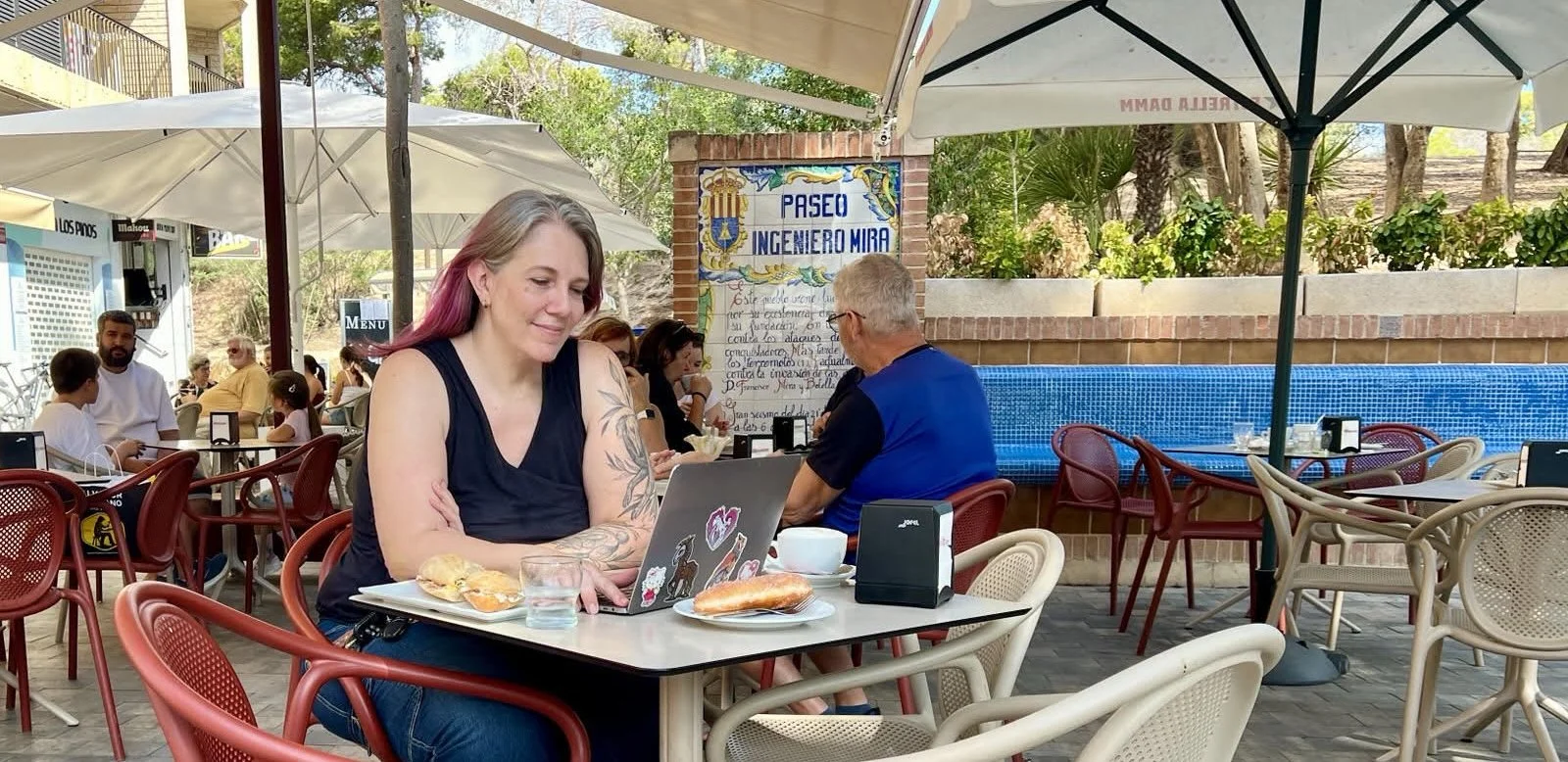
Michael at work in a cafe
For whatever reason, the pieces of fabric immediately became skin in my mind. I was thinking about a woman who had all different kinds of pieces of skin from other people that she had absorbed, and now they’re a part of her. I initially wrote a very short, one-page treatment, which I often do when I have a story idea. It was very sad. It was this arc of this woman who had to absorb other people to create her skin, which meant that she couldn't have long-term relationships. I loved the story. She thinks about the first person whose skin she stole, her mother. Then it leaps forward, and she meets this beautiful young girl in Spain who she, despite her best efforts, does end up absorbing in the end and it's very tragic. I let that story sit and percolate for a little while, but I really didn't want it to be such a tragic story. When I expanded it out, I wanted it to have a happier ending. That was my goal when I sat down to actually write the story. It was to turn that relationship in such a way that, even though it was kind of the same ending, it was happier.
I’d say you did it! It’s important that you gave Raquel the agency to make the final decision. That did a lot of the heavy lifting to make me feel less like somebody was being victimized. Of course, I was shouting at her not to do it, but she didn't listen to me.
Raquel doesn't listen.
No, bless her, she does not. It’s so interesting that this whole piece began as a little one-page treatment.
That's just my process. I always do something like a one-page, not really an outline, almost like a “vibe.” [laughs] I think a lot of writers do that. They have a key scene that is the kernel of the story, the little seed that everything grows from. I don't know how they grow. They just blossom in my head. I have a bunch of these treatments and I just go through them one by one. I think I’m up to about 37 at the moment.
I actually was taking my daughter to college that weekend. I wrote my little one page immediately when I got the original image; that was my gut reaction to the prompt. Then I took my child to Madrid, got her settled in her housing and settled in the University, and then I came home alone. I think that writing that story was cathartic for me because I was embarking on this life alone for the first time in nearly 20 years.
Oh wow, and I can see crumbs of all of that throughout this story. How else does this piece relate to the rest of your work?
I write under several different pseudonyms. And whenever I write something new, I think, “Please, I hope this fits under one of my current pen names so I don't have to start yet another pen name.” I write a lot of different things. The book that I published most recently was cozy and apocalyptic, kind of Gilmore Girls meets Shaun of the Dead.
Oh cute!
The main protagonist is a single mom in her 40s. I do write some action/adventure/romance about a single mom in her 40s, so I ended up putting it under that pen name, Mary Jane Owens, even though there had been no zombies before. [laughs] There are now! Three years ago, I wrote a middle-grade gothic horror under the name Mika Horvath, and this story really relates most closely to that universe. This isn’t really a middle-grade story, but that book was about a vampire. She was a feral girl who grew up alone in the forest. Her house had burned down and she basically grew up in the shell of her house. She ends up meeting a girl who is terminally ill, and they help each other to find a way forward. That book is called Sharptooth because that's how she refers to herself. This story very much has those vibes, but in a very different genre!
Also, you wrote about a writer. Is that a common theme for you?
It is a running joke amongst the people who know me well that all of my stories are self-inserts. All of my main characters are me in some iteration.
I think a lot of writers can relate to that. How is Sia like you?
I think she is very solitary. And I have worn a lot of different hats; I have lived a lot of different lives. I am an immigrant in Spain who came here five years ago. I am not completely alone though – I do have a daughter. I am a single mom by choice, via artificial insemination, but I do have that facet of my personality, that I'm probably never going to get married and settle down and have that normal relationship with another adult human. Also, I'm bisexual. I wish I were a lesbian. I think life might have been so much easier. I don't know.
Is Sia the kind of writer you are, or would like to be? Is writing about European history one of the hats you wear?
Absolutely not. [both laugh] She is a very serious author. I write fluff. I write about feral vampire children and middle-aged moms who are secretly CIA agents and have to fight zombies. I write science-fiction and fantasy, and most of my books have very cozy elements. I am happy to make stuff up. I do not do a huge amount of research. I wish I were the kind of author that Sia is. That was always my intention, but that is not how I write. I write fun, fluffy books with Hallmark endings.
Sia also likes to write in cafes and I hate to write in cafes. I know other people like the ASMR, the background noise of people moving around them. I prefer quiet.
Do you write from prompts much?
I love writing from prompts. I will often go out and find a prompt and write out a scene or a little one-page treatment, anywhere from 500 to 2,000 words, to get that vibe. And I file those away. Then when I'm starting a new project or I realize it's November 1st and I have to write something, I just pull those out, throw together a basic outline, and start writing. I have evolved from a pantser to a plantser, not quite a planner, but I'm trying to move in that direction. I create an outline and then ignore the outline. That's where I'm at in my evolution as a writer.
I think it's really mature to recognize that about yourself.
I love to write with other people. I will, at any point in time, be part of two or three different writing groups. Some groups have weekly prompts, like “Write 500 words based on this term, this character, this basic idea, this image.” I love writing from an image. I had not written a whole story specifically from a garment before, but I do have a treatment based off of a kilt, which I haven’t written the book for yet.
Sometimes I get in trouble. I did this to my friend's husband just the other day. We were in the car and he was talking about one of my books. I said, “You'll really like this other book that I'm planning to write.” I was telling him all about it, and he was like, “Oh my God, I have to read that, send it to me!” And I said, “Oh, I haven't written it yet.” [both laugh] “It’s all up here!” [points to head] He said, “But you know exactly what happens.” And I said, “Yes, and when I sit down to write it, I will write it very quickly.” I generally can finish a book in about a month, at least the first draft. I think part of that is because I let things steep in my head for a while. So I kind of do have the whole story up there. I just need to sit down and write it.
I do get the impression that you work quickly. You mentioned November 1st. Do you participate in National Novel Writing Month?
I do, I have for the last three years. In fact, the cozy-apocalyptic book that I just published in February was my Nano project last year.
Oh congrats! I participated in it once. I… basically succeeded? The finished draft was kind of crap, but there were kernels of ideas that I really liked.
That’s what matters! Just finishing something is amazing. I have three books right now that I finished, but I haven't published yet. There are kernels of good things in there, but it's not cohesive. This most recent book that I put out was actually the fastest time that I've ever done the whole process: sit down, start writing, get the first draft out, do a couple rounds of edits, and actually publish it. November 1st, I started it, and February 14th, I published it. It usually takes me like a year.
For this piece, I did not have an outline. I just had three basic parts: this happens, this happens, and that happens. And I just wrote from that. I only did two rounds of edits on that because I didn't have time really to do any more, which is good because otherwise I would have obsessed about it for a lot longer. I think sometimes, especially when you look at a story as art, it's good to let it go out into the world.
Now that you are on this side of our process, what is your advice for a new person just getting their prompt today?
For me, it's important to let it sit. I have my initial reaction, and then I let it sit for a couple of days and I feel like that reaction matures. It kind of ferments like fungus and it grows new things off of it. It becomes much more interesting.
Call Number: Y130FA | Y131PP.oweCo
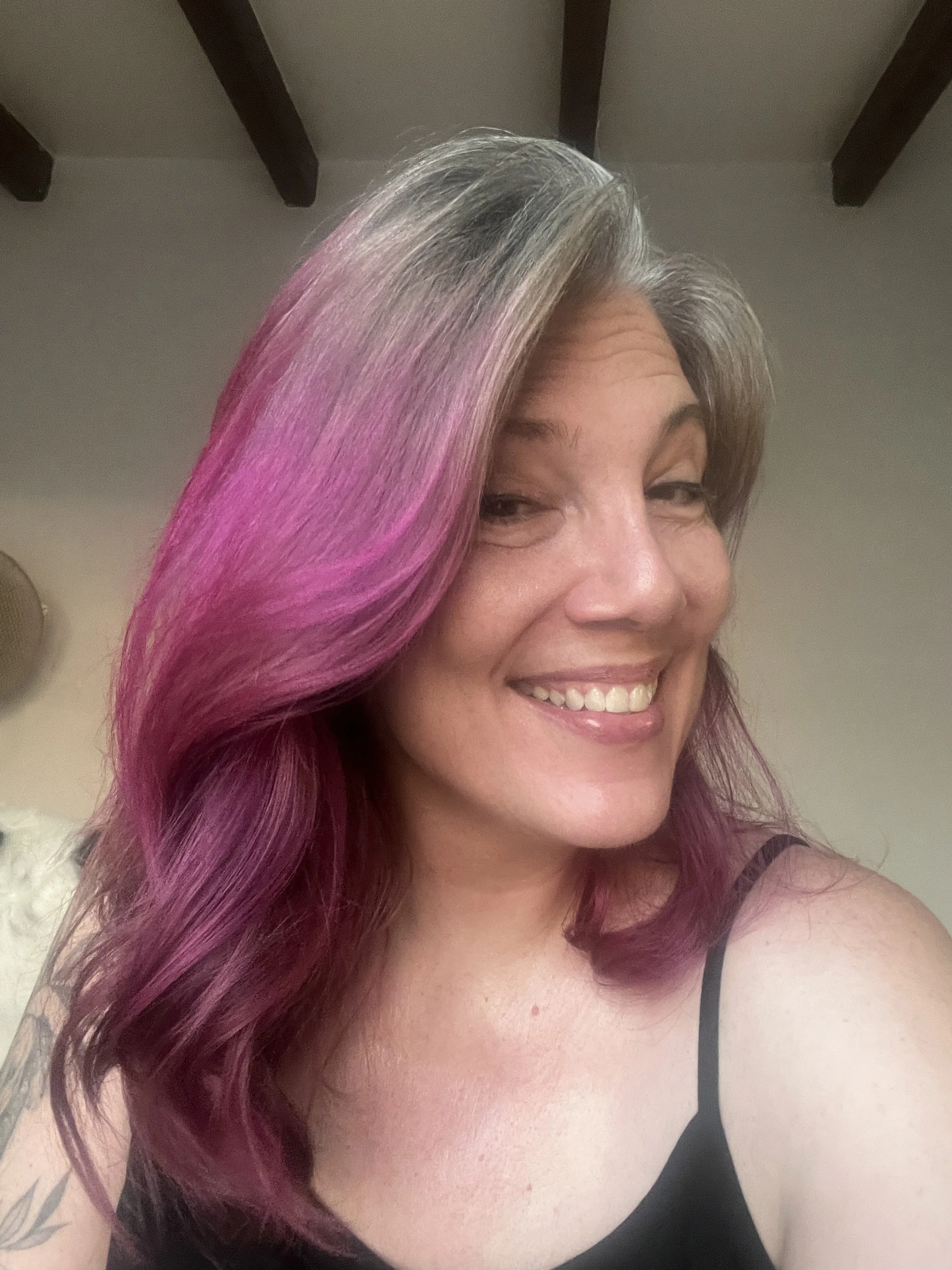
Michael Owens, whose parents should never be allowed to name anything, is an artist, a single mother by choice, and a certified Crazy Dog Lady. During the pandemic, Michael took an early retirement from a career in tech to relocate with her daughter to an old yellow farmhouse near the Mediterranean. There she writes books in multiple genres under various pen names, including Mary Jane Owen and Mika Horvath. You can find her work at http://PepperbackPress.com.