

Made of memories
Abby Neale
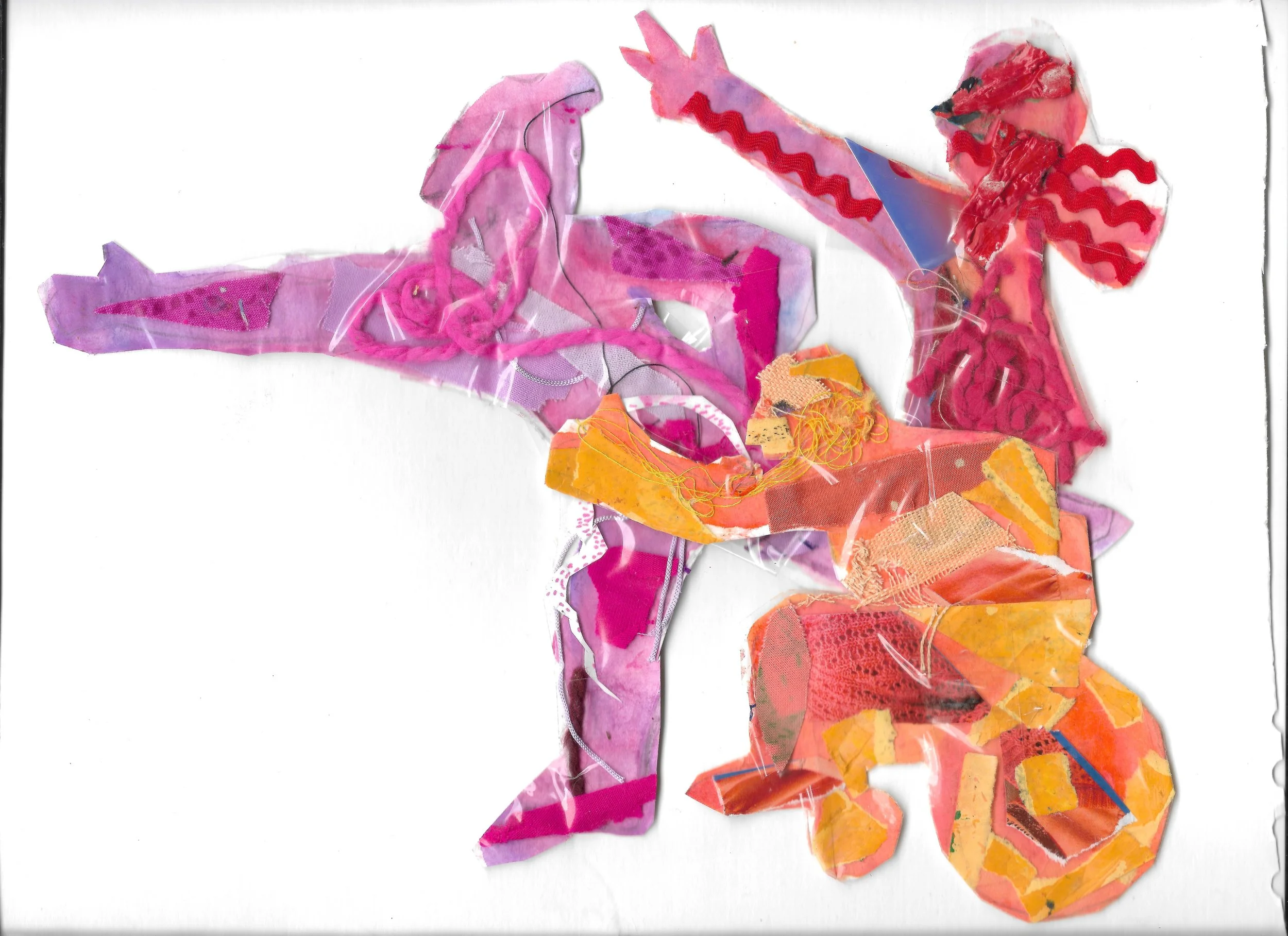
Made of Memories, Mixed media
“I’ve been experimenting with the idea of bodies being defined as a verb rather than a noun or adjective.”
Interview by L. Valena
August 1, 2025
Why don't you start by telling me what you responded to?
With the poem I received, the first thing I noticed was that the color red was carrying a lot of meaning. Which was an exciting challenge for me because I don't use a lot of red, especially to push the possibilities of red as a color with different shades and chromas. The poem also was speaking to bodies as holding memories and transforming over time, and their relationship to each other. Specifically, there was mention of a person in a wheelchair having their relationship with others change. As well as the idea of memories living inside of a body and how clothes might have an effect on the body, especially a red dress.
Cool, what happened next?
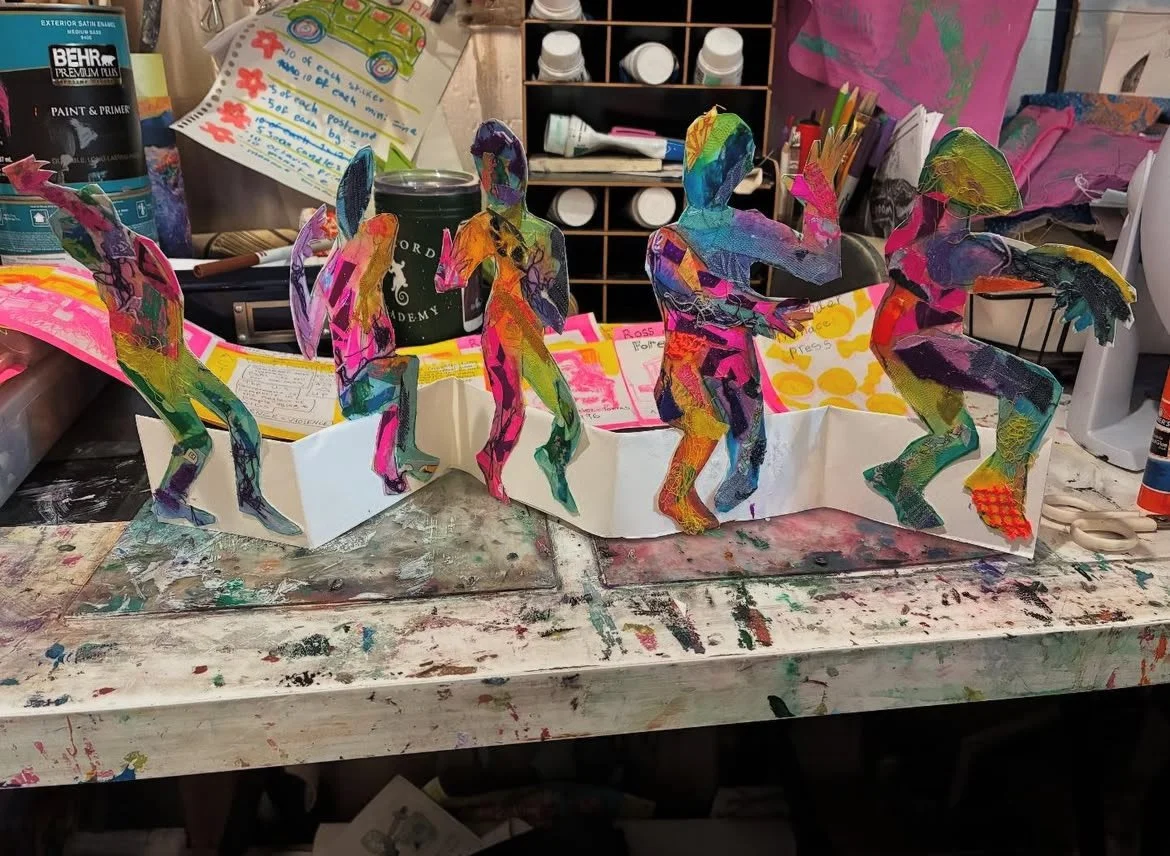
First, I started looking around for anything red I could find in my studio. I'm kind of a hoarder with my materials, so instead of throwing leftover ink away, I’ll smear it on scrap paper or a notepad. I’ll bring these to school for my students to collage with. So, I gathered all of the red scraps I’d accumulated in my studio. I was also thinking about red’s neighbors and cousins—oranges and purples—and grabbed some of those too. I wanted to bring out different aspects and textures of red.
Next I started thinking about this poem’s relationship to the body. Recently I’ve been trying to challenge myself as an artist to incorporate figures or silhouettes that fall outside of ideal norms. When I was learning figure drawing in school, we never got to practice drawing someone in a wheelchair or someone who’d had top surgery, or someone who had a lot of fat around their stomach and chest. I want to push myself to depict people who actually look like those around me and those I love, folks who don’t always see themselves in portraits and artwork.
So, for this piece, I started looking up reference images from a dance company in Boston called Abilities Dance. One image featured a dancer in a wheelchair, a very tall dancer, and a shorter dancer. Their silhouettes formed different levels, and it created a really beautiful composition.
That's so cool. Have you seen their performances?
Yeah, I have. They performed at a teaching conference I attended. The disability-centered dance is so beautiful to watch. It was cool because I had never seen anyone move like that, and you don't often see something for the first time as an adult.
Right, it is really powerful to witness something for the first time as an adult. That's awesome. Tell me more about the piece that you made and your process.
After accumulating all the tiny colored scraps from around my studio, I sketched out the silhouettes, focusing on shapes. I did some wet-on-wet watercolor painting to experiment with a gradient and do something a little out of control, a little free-flowing. It felt like the right thing to do. After that was dry, I collaged over top of it, using the little scraps. Then I cut all the figures out and layered them together like the dance performance depicted.
I love what the different color families do to push the perspective of the work. I think that's really interesting.
Yeah, it actually opened up new possibilities for my work. I'm doing a lot more of those collage figures. I think it might be fun to turn them into an accordion book or something like that.
Do you want to talk some more about how this piece relates to the rest of your work?
I've been experimenting with the idea of bodies being defined as a verb than a noun or adjective. What is the body doing? What is the body doing that’s awesome? Don't people's quirks and abnormalities make life more interesting?
I come to this perspective thinking again about how my education taught me to draw idealized people that don't exist. And that comes from our ableist culture that can be oppressive to people who aren’t super skinny or have an “ideal” body.
I founded Lavender Menace Press in order to give people with marginalized identities a sense of hope and inspiration—a micro liberation in a world of micro oppressions. Part of that work—and it can be hard work from a mental health standpoint—is talking about bodies in terms of what they're doing and feeling rather than how they look. That’s a big part of this project and my work in general.
What else happened? What haven’t we talked about yet?
Clothing and garments come to mind. The poem mentions dressing and clothing in a couple different ways. There’s a sexy red dress, which is really fun. But there’s also a moment in a dressing room that’s really sad in a mundane kind of way.
I used clothing scraps in my piece to create texture. I have a bit of a side quest to stop textile waste. I think it's really shameful how so much clothing is wasted. I have a hard time throwing away clothes that are ripped up. In some ways it feels kind of intimate—your clothing is very close to your body, it carries sense memories. So I've been interested in artistic ways of reducing textile waste. One example is making patches for clothing that is stained or maybe has a company logo you don’t like. It's a way to spend more time with clothing while being able to add to, conceal, or transform garments that might otherwise end up in the waste stream.
Clothing can be a vehicle for expression, much like the dancers’ bodies that inspired my piece. They’re using their figures, their silhouettes, and the colors of the clothes they’re wearing to make a composition or expression. I'm starting to see all the connections between those different artistic media, which is really fun.
Do you have any advice for another artist approaching this for the first time, now that you've done it twice?
Yes. Trust your instincts about your reaction and interpretation of the piece you receive. I'm not that knowledgeable about poetry, nor was I very familiar with electronic music, which was my previous prompt. In both cases I had to apply my art school fundamentals: what colors am I thinking about? Is there a pattern, and does it shift over time? Textures? Then, I would suggest thinking about the “essential ingredients” in the piece that you’re getting and how to take those and make them your own. I’d also say: be resourceful. Poke around the materials you already have and be curious about the possibilities right before your eyes.
Call Number: O131PP | O132VA.neaMa
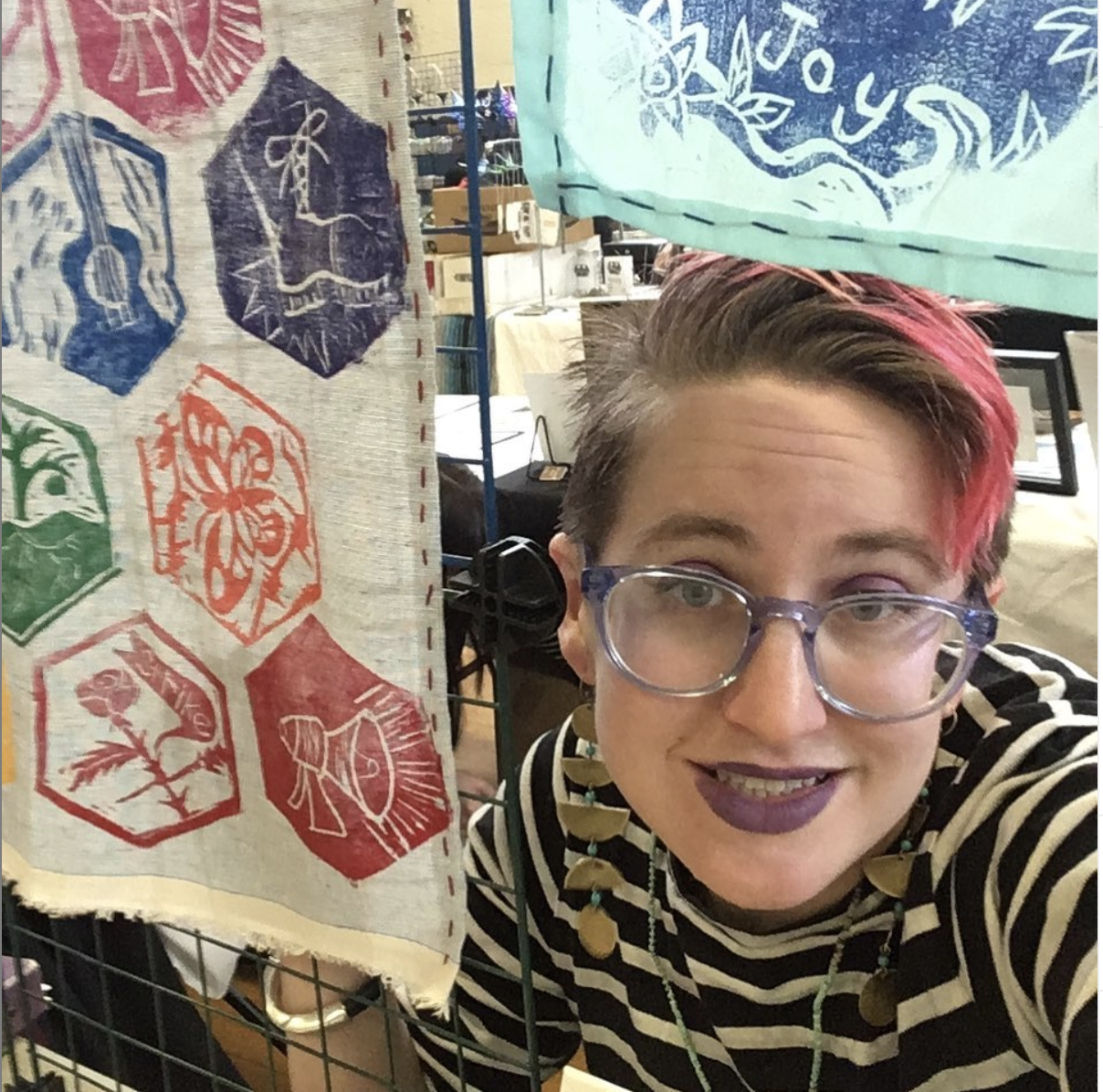
Abby Neale is an artist, activist, and educator based in Boston, Massachusetts. They create zines, prints, and community programming under the moniker of Lavender Menace Press. Their work uses nature, history, and humor to facilitate conversations about social justice movements and creating a more liberated world.