
Cowboy Keonte
Justice Dwight
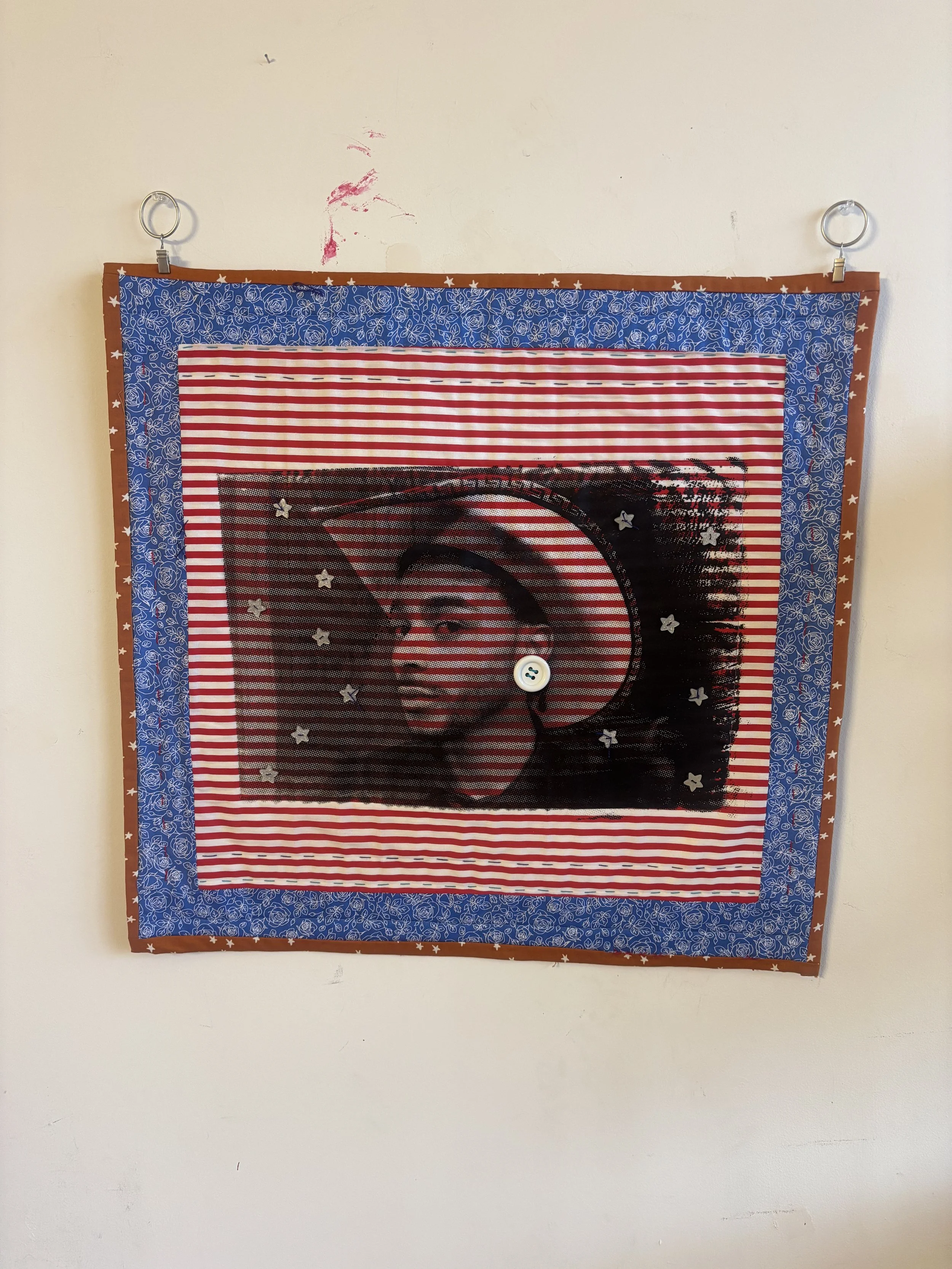
Cowboy Keonte, Screenprint on quilt, 19 x 23 inches
“Without community, we can’t go into that place where hopefulness feels like a real, tangible thing.”
Interview by L. Valena
November 4, 2025
What was the prompt that you responded to? Can you describe it for me?
It was a poem on note cards. The first line really stood out to me because I feel like we're in a situation right now, in general, as a whole. It made me think about that, and then the red, white and blue from the note cards also stood out to me.
What happened next? What were your first thoughts and feelings?
I've been thinking about what the American dream would look like if it existed, and more specifically, what a Black queer American Dream would look like. I sat with one of my good friends and asked him if he would pose for the picture. So that's my friend Keonte in the picture. I just wanted to do something that felt very American like the cowboy, and show this Black queer person in that style. Then I decided to screen print the image onto fiber and start the quilting process.
Yeah, it's so cool that you made a quilt. Is that something that you've been doing for a long time, or something you just started?
I made my first quilt in March. That quilt got a good response, and a gallery here reached out and wanted me to do an entire quilt show. But the catch was that this show was in July! I did it, but it was quite a lot of sewing.
Wow, good job. Sometimes you just got to crunch, right?
It seems like all the time these days.
I know. I love this question about what an American Dream would look like, if it existed. That's a really powerful question.
Thank you. Right now, there's just so much going on politically, and I've been rattling with how I can create more space in my artwork to show that not only are we here now, but we've been here before, and will be here later. That poem really sparked something in me, and that first line just stood out. Now, I don't know what the poem is actually about, and I'm sure it maybe has nothing to do with anything I'm talking about...
But “In situations such as these” is such a powerful line when we're looking around and asking what is going on right now. What is this situation?
Where are we? It feels so foreign and so crazy. That line just stuck with me. I read it and went to bed, and I woke up the next day thinking about it. Dang, this situation that we're in just feels kind of shitty. So how do I create something beautiful and full of memory without it being tragic?
Yeah, big question.
That's how I came to the quilt. For me, quilts do hold a lot of memory and they are filled with comfort. I think it's funny because you guys always catch me when I'm in an experimental place. The first time I participated, I did a painting, but the second time it was a collage, and now it's a quilt. Next time, it might be a statue.
Or music!
[Laughs] Who knows?
Something I'm getting from this piece is hopefulness. But also something about feeling open to patriotism, if this country actually lived up to the words that it says it stands for.
You understand! I asked my muse to think about this Black, queer, American dream and it was very much a question. It's not something I thought about, but it also definitely feels so far removed right now from anything we've been taught we were promised.
We'll never get there if we don't start saying what we need and want, and being clear about it, right? It's not our fault that we're in this situation, but we cannot get where we want to go if we don't say where we want to go. There's a hopefulness in there that I'm finding in this piece.
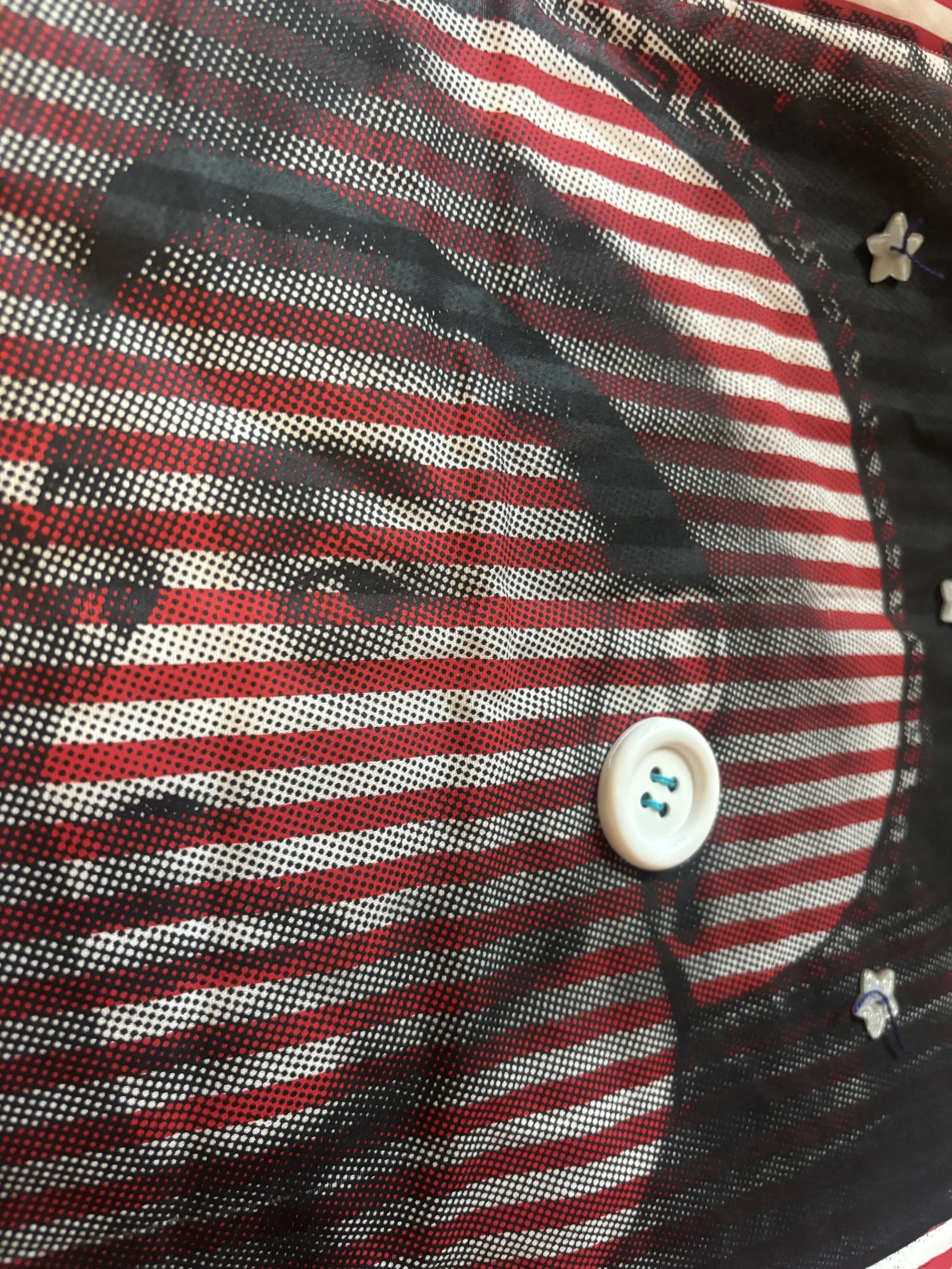
I tried to be very intentional with how I created it, and I feel like it's very in-your-face. It's a re-imagining of Americana vibe. There are 13 star buttons on there for the original colonies; that’s what I was trying to channel. The blue and white rose fabric is because, apparently, Ronald Reagan made the rose the official flower of the United States during his presidency even though they're not native to us. And then I thought about what the Cheeto is currently redoing. I think he tore down the Rose Garden – I don't know what he's done anymore. It's something new every day. So that's why I included the rose. I also thought about the image of a rose growing through the concrete. There were a lot of thoughts happening, and a lot of discomfort. In some ways, I see a lot of American imagery as being ominous. So it was interesting to add a hopefulness and maybe a sense of joy to that.
I think there's a real playfulness in this button earring.
It's funny you say that. Me and this friend, we worked at a company together. We sold clothing and jewelry, and he always used to wear one earring. And it was always just like this outrageous earring from the company we worked for. I put the button in his ear because he wasn't wearing earrings that day, and I thought something's missing. I'm glad that the earring helped add to the narrative of his queerness. I felt like it helped bring that story through.
Absolutely, I love it. It's cool to see you working in screen print as well. Talk to me more about that.
Thank you. Being able to do the photography has been fun. I was a person who used to use references that were already around, and add narrative to those that fit the stories I wanted to tell. But now I'm actively looking around me and my community to pull from the stories near me to tell those. I'm grateful that people are trusting me with their stories and their image. Last year, I did a studio access residency here at Vis Arts. I got to have access to different things I never had as a self-taught artist, like screen printing, ceramics, and glass. Having that opportunity to try stuff was really good.
This is a rabbit hole, but this journey started because my art was stolen from me by Ross (the store). They made an AI image of one of my paintings, and sold it worldwide. At the time, there was nothing I could do about it because of the lack of laws around AI. As a self-taught artist, I just felt like there was nothing else I could do. But my amazing partner and some really good friends pushed me to apply for this residency. I did it, but when I got there I felt like I didn't know what to do with myself. I started trying to teach myself how to utilize AI. So a lot of the quilts that people see on my page from the last show I did have images on them that are not real people. They are people I created.
And I tried to figure out ways to use AI ethically. Not only did I create them down to every detail, from the clothing to what kind of jewelry they were wearing or how many stripes were on their shirt, but I also wanted to cross-check AI. I did a Google image search of what I’d created to see if anything else would come up. If a real person came up, or someone else's art came up, then I felt like I wasn't doing a strong enough job at creating the prompt. It felt like a reclaiming of AI. After I made the images, I began to screen print them just on paper. Then randomly I had some fabric laying around and tried that. I went to a Bisa Butler talk here in Charlottesville, and the finale show for the residency was coming up, so I decided to make a quilt. I loved Bisa Butler already. Seeing her in person was crazy and she knew who I was, which also blew my mind.
Oh my god, that's amazing. I love her work. I have one of her prints right here in my studio!
I took the AI images, screen printed them onto the fabric, and then made them into a quilt. After doing that, everybody thought the people were real. I was very transparent that they were not, and that I was trying to use AI ethically, as a way to heal from the trauma of having my work stolen by AI. But then it made me remember that our happiness is not an illusion. So that's how I got on this path of really being intentional about the community around me and sharing their stories. Without community, we can't go into that place where hopefulness feels like a real, tangible thing.
I'm back in residency at the same place. I got a year-long residency, which means that now I have a private studio for the first time in my entire art career.
Congratulations, that's amazing. Well deserved.
Thank you so much. It's been really nice to just go in there and dream a little, you know? Throughout my process of learning how to sew, I learned that my great-grandmother was a quilter, and my grandmother was a crochet artist, and then my other grandmother was a seamstress. These are things that I learned. So every time I'm in front of fiber and I'm doing it, I almost feel like there's some kind of energy being channeled through that. So shout out to them for paving the way.
It's so special that you have this in your lineage!
Everybody assumes I sew because I dress a little kooky, but I just do a lot of thrifting. Now I do sew, so maybe there will be clothes next.
Once you start...
... you can't stop! It's addictive because it's meditative. Maybe a big takeaway from this whole thing is that having new processes in my work is more meditative than what I was used to.
Awesome. Do you have any advice for another artist? I mean, this is your third time participating. Is there anything new coming to mind?
You don't have to really dig super deep to find the meaning in what you're looking at. Just pull out the things that mean something to you and see where that takes you. I think that's where you find the fun in this process, because it is fun, and I think it was created to be fun and to connect people from all over in this crazy way. If you just put the things out to keep it fun, you'll have a good time. Don't overthink it.
Call Number: V100VA | V101VA.dwiCo
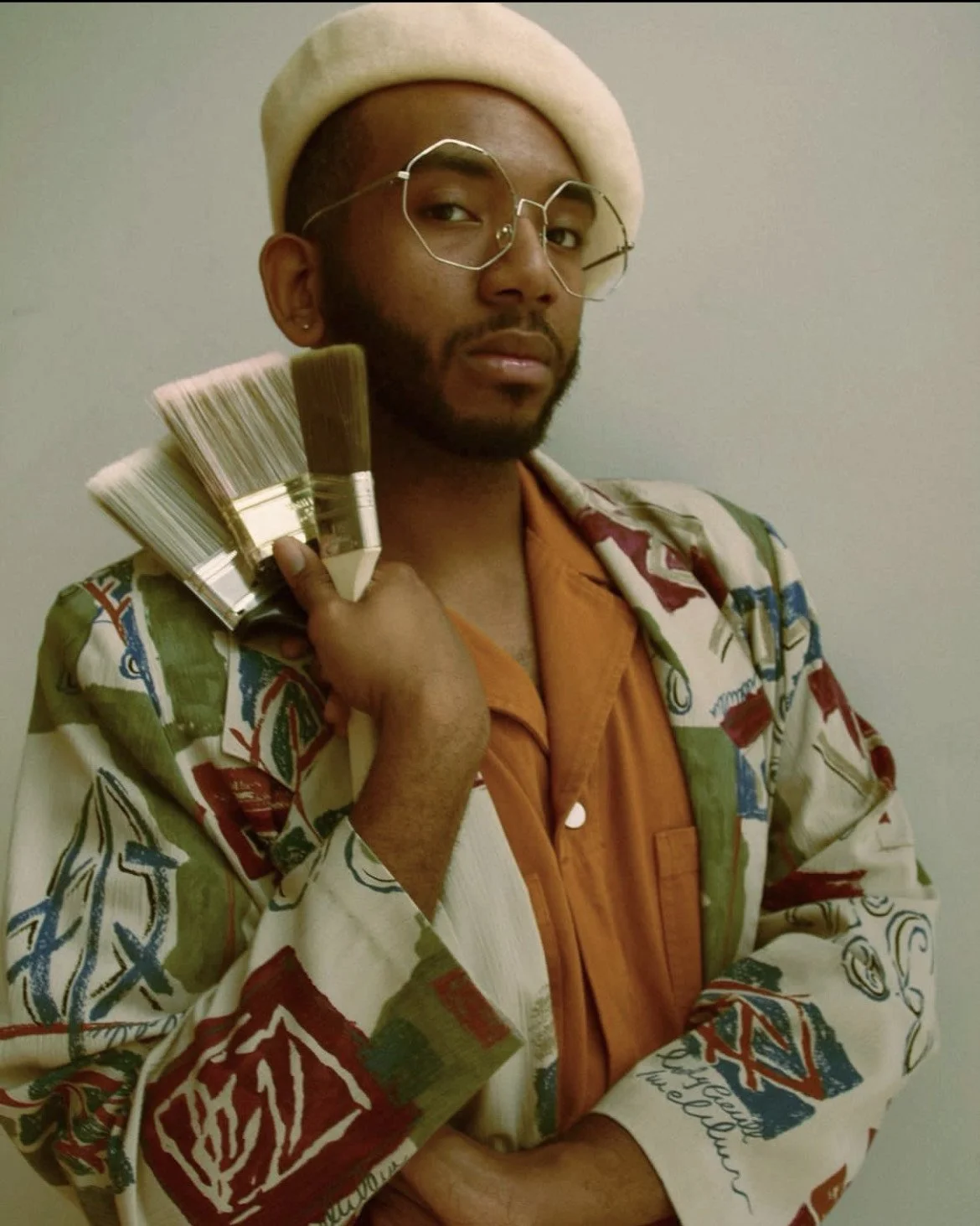
Justice Dwight Is a self-taught visual artist who was born in Plainfield New Jersey but raised in Richmond Virginia. Besides being inspired by his family, he looks up to Black artists like Barkley Hendricks, Bisa Butler, and Derrick Adams. While also being in group shows, he's had the pleasure of sharing his art online which has given me the opportunity to create work for the University of Maryland and celebrities such as Issa Rae, Big Freedia, and Azealia Banks.